

In this interview with Mads Thunestvedt Hansen at Mandag Morgen in Danish, Yuen Yuen Ang introduces “polytunity” as a counter-narrative to “polycrisis.”
“It is only when the old order breaks down that we are forced to reflect on what went wrong.” Polycrisis reflects Western anxiety over the decline of the old order. Polytunity, on the other hand, sees breakdown as a once-in-a-generation opening for new voices and new directions.
“We must move from a polycrisis to a polytunity”, Interview originally published in Danish in Mandag Morgen, 21 May 2026. Translated into English.
The concept of polycrisis has been central in describing the many overlapping crises the world faces today. But the concept focuses primarily on fear, and not the opportunities—for new voices and new directions—that emerge when the old global order breaks down, argues political economist Yuen Yuen Ang. She instead proposes the concept of polytunity.
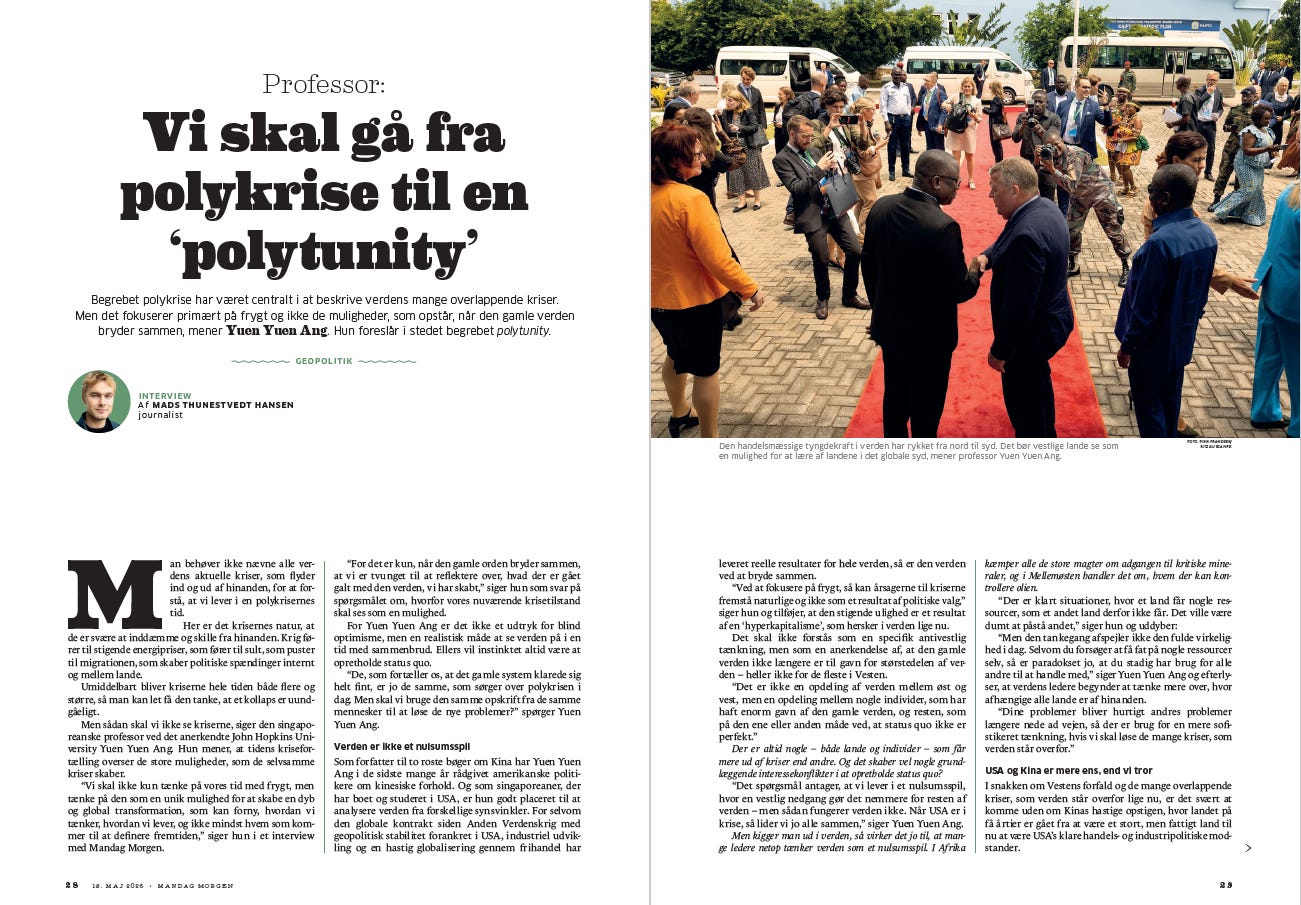
Talk of a world in crisis has been with us for years now. One hardly needs to list the crises anymore—they bleed into each other. War drives up energy prices; higher energy costs fuel hunger; hunger accelerates migration. The spiral continues. Crises, by their nature, cannot be contained, as the widely discussed concept of polycrisis suggests. They multiply and compound. Read enough bleak headlines and total collapse can start to seem inevitable.
But that is not how we should view crises, says Yuen Yuen Ang, a Singaporean political economist at Johns Hopkins University. The crisis narrative, she argues, blinds us to the opportunities these very crises create.
For Yuen Yuen Ang, polytunity is not just optimism, but realism—true renewal only becomes possible in times of breakdown. Otherwise, the instinct is to maintain the status quo.
The term “polycrisis” was popularized by Adam Tooze at the World Economic Forum in 2023, who defined it this way: “Here is your fear, here is something that fundamentally distresses you. That is what it might be called.”
“We should not think of our time with only fear, but as a once-in-a-generation opportunity for deep transformation of global thought and governance: how we think, the way we live, and who gets to define the emerging future,” says Ang.
“It is only when the old order breaks down that we are forced to reflect on what went wrong.” Asked why crisis should be seen as an opportunity, she is unambiguous. For Yuen Yuen Ang, polytunity is not just optimism, but realism—true renewal only becomes possible in times of breakdown. Otherwise, the instinct is to maintain the status quo.
“Yet notice this: the voices who told us that the old system was doing fine are the same ones mourning the polycrisis today. How can the same prescriptions from the same sources solve new problems?” she says. The same people and institutions still dominate global discourse, even as the conversation has shifted from celebrating Western ideals of freedom to cataloguing crises.
“You can see it as a loss of power and dominance, but that mainly leads to fear and political paralysis,” she says, “Or you can see it as an opportunity for Western countries to start learning from the global South.”
Ang adds that even her college-age students recognize the blind spot. One student contributing to her “Polytunity: The Gen-Z Series” on Substack, wrote: “The polycrisis is not breaking students. It reveals the limits of machine logic.”
In short, what is missing is not simply hope—but new voices and new directions.
The World Is Not a Zero Sum Game
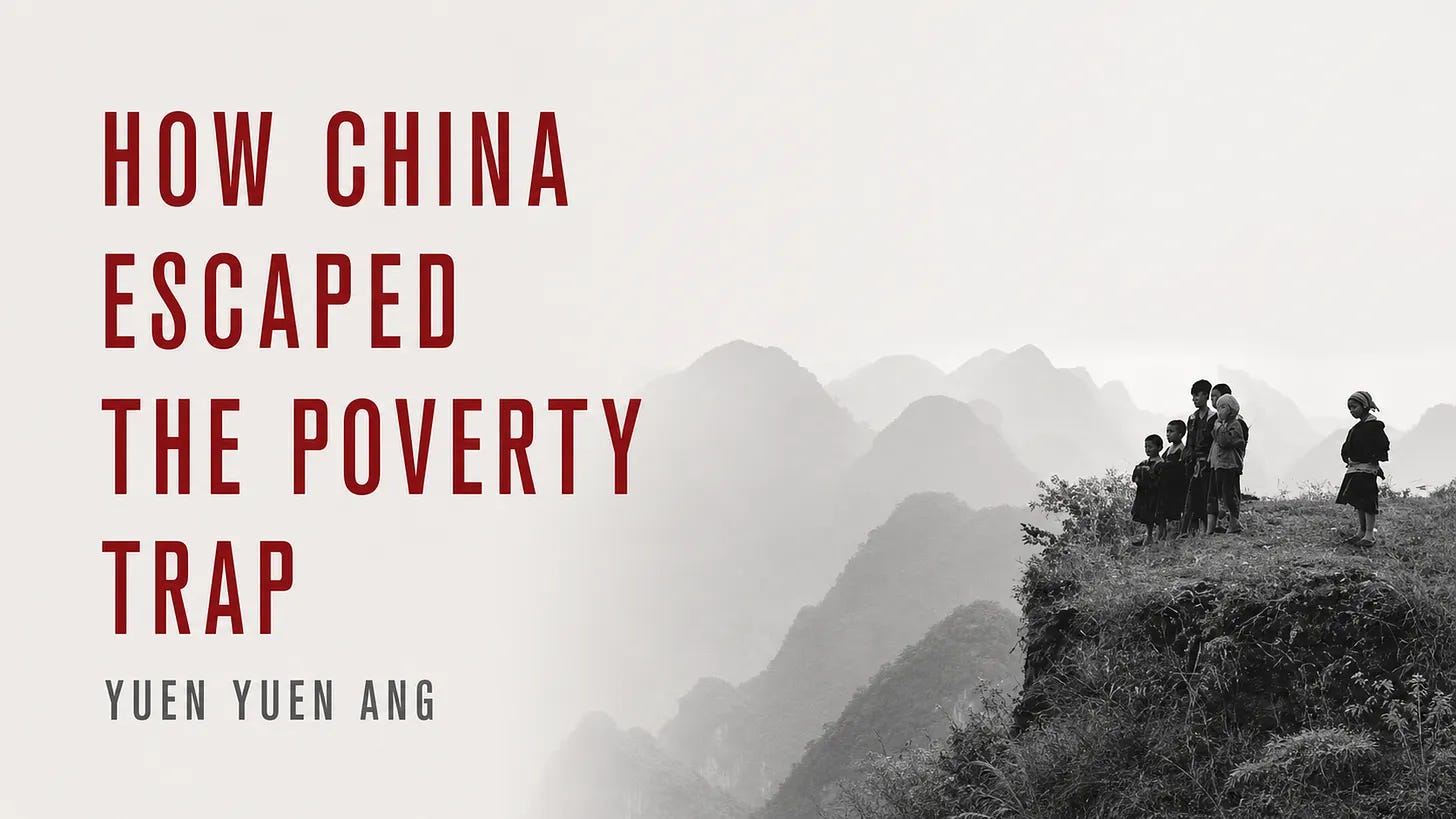
As the author of two acclaimed books on systems thinking and China, Yuen Yuen Ang has advised U.S. policymakers on China policy. As a Singaporean who has lived and worked in the United States, she is well placed to read the world from multiple vantage points. The postwar global order—built on geopolitical stability anchored by the United States, industrial development, and rapid globalization through free trade—produced real results worldwide. But according to Ang, that order is now breaking down.
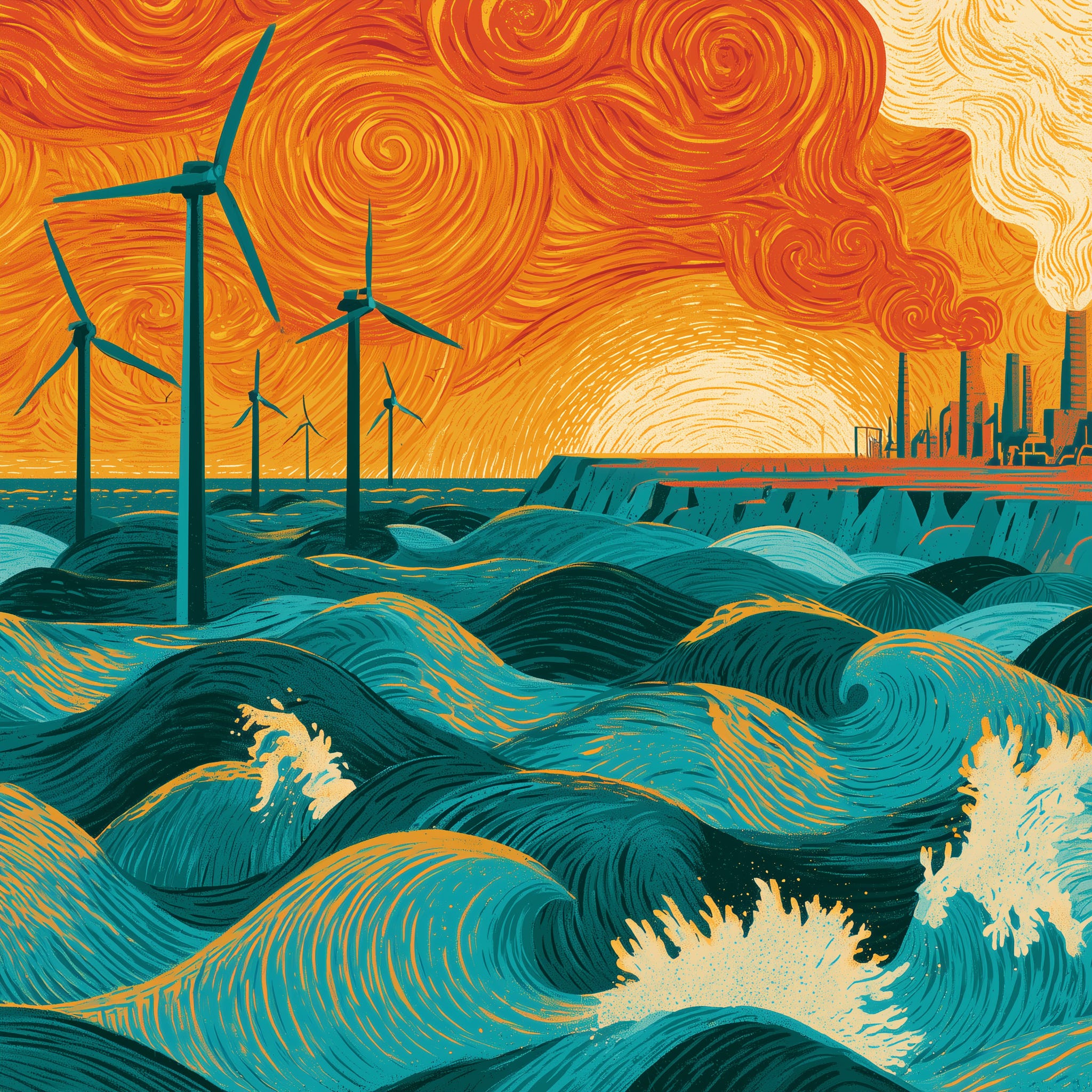
“By fixating on fear, the ‘polycrisis’ abstracts the causes of crises, making them appear like natural disasters rather than systemic outcomes; for example, rising inequality results from hyper-capitalism, and climate change proves the limits of industrial extraction.”
This is not anti-Western thinking. It is a recognition that the old world no longer works for the majority of people—including those in the West.
“It is not a division between East and West, but between individuals who have greatly benefited from the old world and the rest, who in one way or another know that the status quo is not perfect.”
MT: There are always some, both countries and individuals, who benefit more from crises than others. Does this not create fundamental conflicts of interest in maintaining the status quo?
“That assumes we live in a zero sum situation, where Western decline benefits the rest of the world. But that is not how the world works. When the United States is in crisis, we all suffer,” says Ang.
MT: But looking at the world, many leaders seem to think in zero sum terms. In Africa, major powers compete for critical minerals, and in the Middle East it is about controlling oil.
“There are certainly situations where one country gains resources that another does not. It would be foolish to deny that,” she explains.
“But that kind of thinking does not reflect the full reality today. Even if you try to secure resources for yourself, the paradox is that you still need everyone else to trade with,” she says, calling for leaders to recognize how interdependent countries are.
“Your problems quickly become someone else’s problems further down the line, so we need more sophisticated thinking if we are to solve the many crises the world faces.”
“Must development always move from north to south, from rich to poor, from modern to traditional, or can we actually learn from each other in ways that help us rethink the crises that define our time?”
The United States and China Are More Similar Than We Think
In discussions about Western decline and overlapping crises, it is impossible to ignore China’s rapid rise. In just a few decades, it has gone from a large but poor country to a major trade and industrial rival to the United States, regardless of whether Democrats or Republicans are in power.
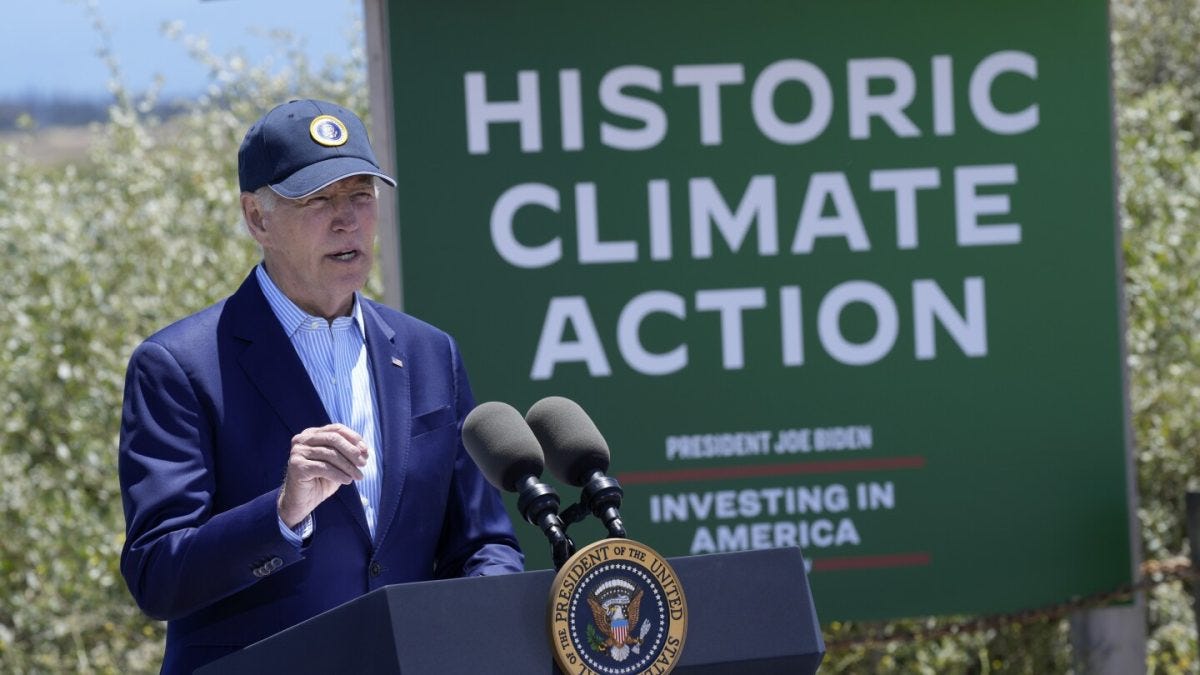
A few years ago, Joe Biden attempted to kickstart green industrialization through large scale tax incentives such as the Inflation Reduction Act, while Donald Trump sought to curb China’s trade power through tariffs. But according to Ang, the United States and China have more in common than many believe.
“We often analyze international relations through opposites. During the Cold War, it was the United States and the Soviet Union, and now it is the United States and China,” she says. This way of thinking leads people to assume that one side will eventually collapse while the other will win.
“It is like a script with a plot, characters, and stereotypes that shape a particular viewpoint.
“But if you look closely, the United States and China are more alike than most people think.”
MT: How?
“They share a similar struggle with the problems of capitalism. It is a battle between two gilded ages, where both countries have extreme inequality, elite dealmaking, speculative bubbles, and the rise of powerful figures in technology and finance not seen since the nineteenth century,” she says, noting that the primary difference is that one is a democracy and the other is a one party state.
“By thinking about relations between the United States and China in this way, we can challenge the binary understanding that dominates today. The challenges are largely the same in both countries: inequality, greed, and high living costs.”
“So when we share many of the same problems, we can also find shared solutions.”
The World Does Not Have to Become Like the West
For Ang, the answer is not more of the same. Since the end of the Cold War, the prevailing idea has been that the rest of the world simply needs to catch up with the West—to move, in the old language, from the third world to the first. Ang sees this as a mechanistic way of thinking about deeply complex problems.
“Our modern existence is defined by industrialization, where we instinctively see the world as a simple machine, where pressing the right buttons produces a desired result.”
“But for many developing countries, this becomes a limiting vision, because the destination is already predetermined by more powerful countries.”
For Ang, Western countries must also recognize that they can learn from the rest of the world if we are to turn the polycrisis into polytunity. Already, the center of economic gravity has shifted from north to south, reducing the West’s global appeal. According to Ang, the West can see this as either a threat or an opportunity.
“You can see it as a loss of power and dominance, but that leads to fear and paralysis,” she says.
“Or you can see it as an opportunity for Western countries to start learning from the global South.”
She asks: “Must development always move from north to south, from rich to poor, from modern to traditional, or can we actually learn from each other in ways that help us rethink the crises that define our time?”
Translated from Danish and reprinted from Mandag Morgen
Learn More
How does Gen-Z apply concepts from APE and AIM? Read Polytunity: Gen-Z Series, a curation of essays by Ang’s students at Johns Hopkins.
Read The Clash of Two Gilded Ages: The U.S. and China are more similar than most people think.