
Polytunity: The Gen-Z Series
Reflections from college students on coming of age in a time of global disruption

Gen Z—short for Generation Z—refers to people born roughly between 1997 and 2012. Today, many of them are undergraduates in my classes. They grew up with smartphones and social media as indispensable parts of life. They are also the first generation to confront the disruption of AI to higher education and the white-collar job market.
But there is something even more consequential about their historical moment. This generation will come of age during the transition from the post-1945 world order to a still-emerging one.
For those who frame this transition as polycrisis, it may seem dreadful to be young during a time of breakdown. But if we view the moment instead as polytunity—a rare opening for reflection and transformation—then Gen Z may possess extraordinary agency to interpret and shape the future.
We’re excited to launch Polytunity: The Gen-Z Series—beginning with this editor’s note, followed by a series of essays from students in an undergraduate course I am teaching at Johns Hopkins (JHU) in Spring 2026: From Polycrisis to Polytunity.

Polytunity as Moment, AIM as Paradigm
For readers new to this Substack, polytunity reframes the current era of disruption as a generational opening for deep, constructive transformation, rather than a condition defined only by fear and paralysis. To seize this opening, I advance a new intellectual “operating system”: AIM (Adaptive, Inclusive, Moral Political Economy).
AIM rests on three simple but powerful principles:
Adaptive: Seeing societies as complex adaptive systems, not machines
Inclusive: Amplifying diverse, indigenous pathways
Moral: Correcting normative biases and imbalances in knowledge production
I originally developed AIM within my own field of global development. Over time, however, I came to see it as something broader: a systems-based, pluralistic, and reflexive way of thinking about the world—and indeed, as Lily (one of the writers) puts it, “a way of life.”
And sometimes, the people who grasp this perspective most clearly are not celebrities or experts, but students.
If we view the moment instead as polytunity—a rare opening for reflection and transformation—then Gen Z may possess extraordinary agency to interpret and shape the future.
From Term Papers to Public Writing
My 2026 course at Johns Hopkins University—Turning Polycrisis into Polytunity—has a simple premise: if disruption defines our era, then the ability to interpret and communicate about disruption is an essential civic skill.
Yet in academia, student writing often disappears into a familiar routine: a term paper written for a professor, graded, and then quietly forgotten.
I wanted to try something different. Instead of traditional term papers, I invited my students to write public-facing Substack essays.
Writing for a public audience requires concision, clarity, and the courage to express oneself. In many ways, this is more demanding than a term paper, because it requires a deeper grasp of the underlying ideas in order to interpret them meaningfully.
Letting Gen Z Speak for Themselves
This experiment also corrects a persistent asymmetry of voice. Gen Z is endlessly discussed as an abstract category. Professors, journalists, consultants, marketing companies speak about them, frequently lamenting that college students no longer read books, or speculating about their anxieties and habits. Yet we rarely hear directly from them.

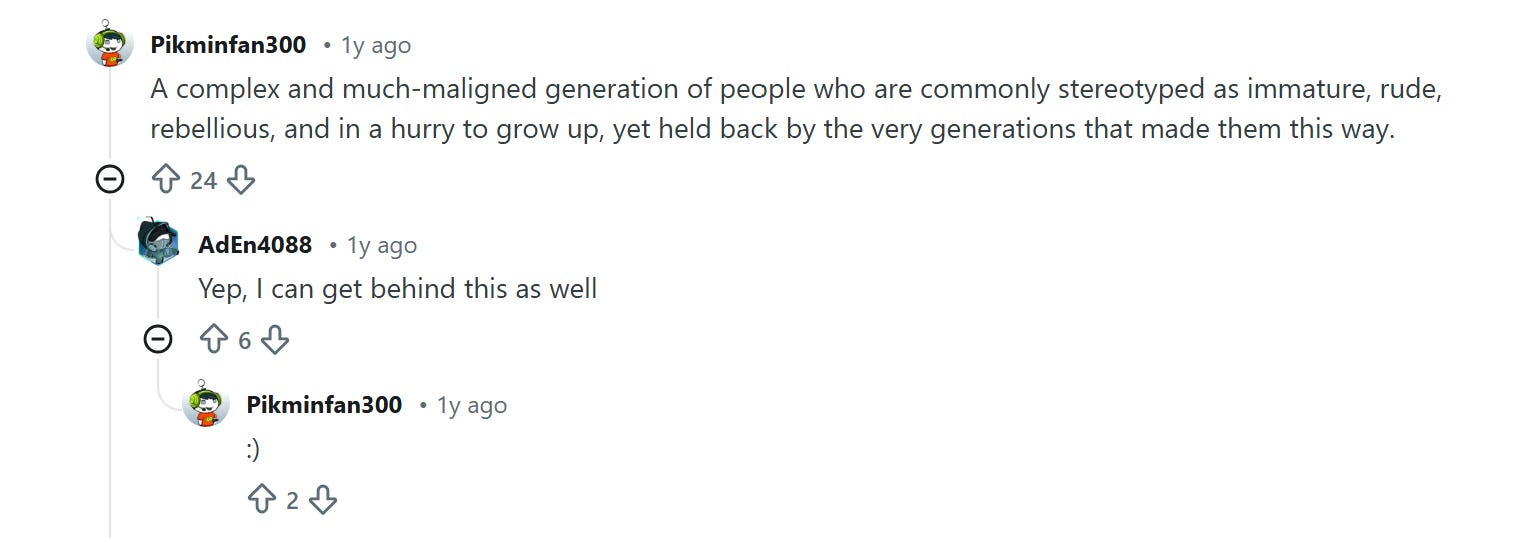
Through this small step of letting Gen Z speak for themselves, this series practices—not just theorizes about—the Moral pillar of AIM.
In this series, I asked students to reflect on questions that matter personally to them:
What is their experience of coming to age during an age of disruption?
Does Polytunity, AIM, or its conceptual components (e.g., complex vs. complicated, control vs. influence, how power shapes ideas) resonate—or not?
How might they reinterpret their experiences in light of what they’ve learned?

If disruption defines our era, then the ability to interpret and communicate about disruption is an essential civic skill.

Three Gen-Z authors will approach these questions from very different and personalized angles.
Ambre Clermont reflects on a ritual among college students: the “three-year plan.” Many students are taught to map their futures in linear steps (university → internship → job →promotion) as if operating a machine. Yet these carefully calibrated plans collide with a relentless stream of dystopian narratives about the “polycrisis.” Ambre’s key insight: the anxiety many young people feel stems less from crises themselves than from the mismatch between the machine logic they are taught and the disrupted world they inhabit.
Lily Yan reflects on her journey immigrating from China to America through the language of AIM. When immigration is treated as merely complicated—like a toaster—it becomes a checklist of steps. But when understood as complex—like entering a forest—it becomes a process of adaptation and growth. Lily makes a further distinction: adaptation ≠ assimilation. Assimilation demands homogenization; adaptation means integrating while preserving one’s identity.
Joy Yu illustrates mechanical vs. non-mechanical social worlds through an ordinary activity: shopping for produce. In her grandmother’s hometown of Nanjing, the local market appears chaotic but is woven together by relationships. Her grandmother’s kitchen is sparse not because of scarcity, but because neighbors routinely share and borrow. This communal ecosystem stands in contrast to the industrial, hyper-individualized structures that characterize urban life.
Over the next two weeks, the Polytunity Project will share these essays on Substack. Special thanks to Prakhar Misra, who shepherded this pilot behind the scenes.
I hope you enjoy reading them!
To Learn More
The Global Polytunity at Project Syndicate: “Polytunity is not a call for naive optimism in the face of existential threats. Instead, it represents purposeful realism that draws on the creativity of a genuinely global community.”
Yuen Yuen Ang’s introductory essay on AIM (Adaptive, Inclusive & Moral Political Economy) at Oxford Development Studies