
Is Complex Another Word for Complicated? No, and Why it Matters.
Yuen Yuen Ang's Interview at Princeton University

Complex describes systems with interconnected elements that adapt to one another (like trees), whereas complicated refers to mechanical objects composed of separate parts that are controllable (like toasters).
Imagine managing living forests as if they were static rows of toasters. If that sounds absurd, realize that this is how technocrats and social scientists often approach political economy: mistaking the complex for the complicated.
In this interview with Princeton University’s World Politics, Yuen Yuen Ang explains why distinguishing between “complex” and “complicated” matters for political economy—and why we must also confront how power and normative biases shape knowledge production.
Emily Babson in Conversation with Yuen Yuen Ang: “Complex Doesn’t Mean Complicated—and Why It Matters,” World Politics (Princeton University), February 24, 2026
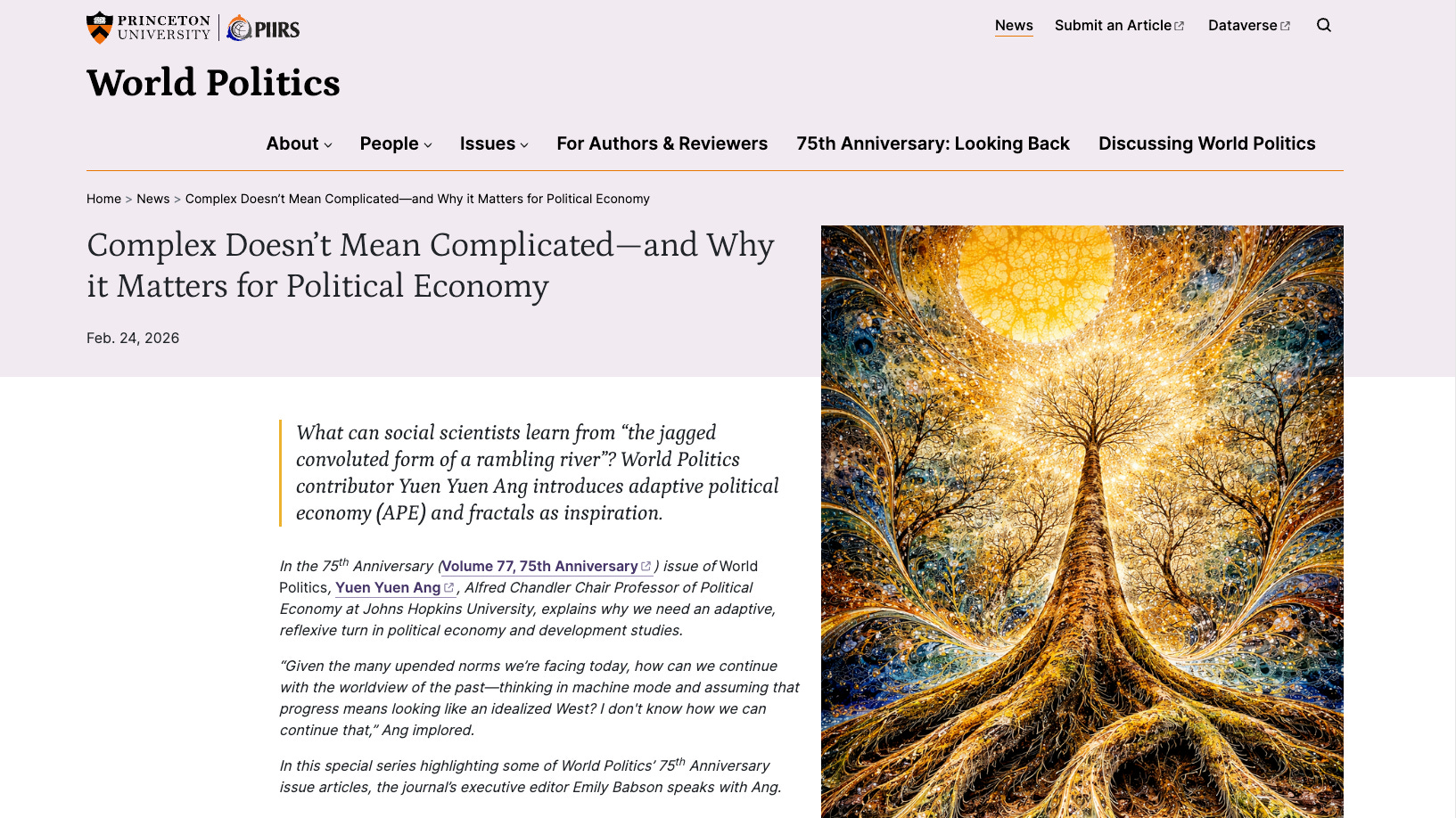
What can social scientists learn from fractals—“the jagged convoluted form of a rambling river”?
In the 75th Anniversary issue of World Politics, Yuen Yuen Ang, Alfred Chandler Chair Professor of Political Economy at Johns Hopkins University, speaks with executive editor Emily Babson, on why we need an adaptive, reflexive turn in political economy.
“Given the many upended norms we’re facing today, how can we continue with the worldview of the past—thinking in machine mode and assuming that progress means looking like an idealized West? I don’t know how we can continue that,” Ang implored.
World Politics: Your article introduces adaptive political economy. Tell us about it.
Ang: Adaptive political economy (APE) is a paradigm that studies political economies as complex adaptive systems, rather than as complicated objects. I begin by making a basic ontological distinction: complex does not mean complicated (ontology are inquiries about the nature of matter and their classification). In common and academic language, these two words are conflated, with “complex” often connoting messiness. This is a mechanical mindset applied to non-mechanical realities.
Complicated means objects made up of separate parts that do not adapt or change over time, like a toaster. Complex, by contrast, are systems comprised of elements that constantly adapt to one another, like trees. Complexity has hidden orders; it is not chaos. APE is a paradigm aimed at developing concepts and methods to reveal and map out these orders, rather than simplifying them away.

World Politics: Why do you call APE a paradigm, not a theory or framework?
Ang: A theory is an explanation for a particular problem, whereas a framework is a static checklist. A paradigm, on the other hand, is a generative worldview—a way of studying the world based on core assumptions about the nature of humans and societies. As the 2019 Nobelist Ester Duflo said literally, economists tend to “think in machine mode.” They treat political economies as machines; press the right button (the “root cause”) and you will get the desired outcome.
Yet in reality, political economies do not resemble machines, especially on big questions that matter such as modernization, wars, financial crashes and recovery. What Duflo described is not a theory or framework, but a paradigm—the industrial paradigm—reducing highly complex social problems to toaster-like things.
The industrial paradigm is flawed because it contradicts social reality. Modern social science was born in an age of mass industrialization. That context has a profound, invisible influence on our ontology. We lack basic concepts to recognize systems that are not like toasters. They are perceived as nuisances, complications that stand in the way of advancing “parsimonious” social science theories.
Thus, in APE, I begin by underscoring a classification error. It is an error to treat societies as complicated, because they are inherently complex, with mutually adaptive elements producing outcomes that may be influenced, but not controlled. Making this ontological distinction is the first step toward a paradigm shift, because if the subject (like development) is misclassified, more errors will follow.
World Politics: In articulating APE, you took inspiration from fractals. Can you tell us more about fractals, who discovered it, and why it matters for the political economy of development?
Ang: I was looking for a meta-analogy that could explain the ontological error commonly made in social science, and fractals stuck out to me. Social scientists emulate mathematics because it is the kind of universal Newtonian truth the profession aspires toward. But fractals opened a radically different kind of mathematics.
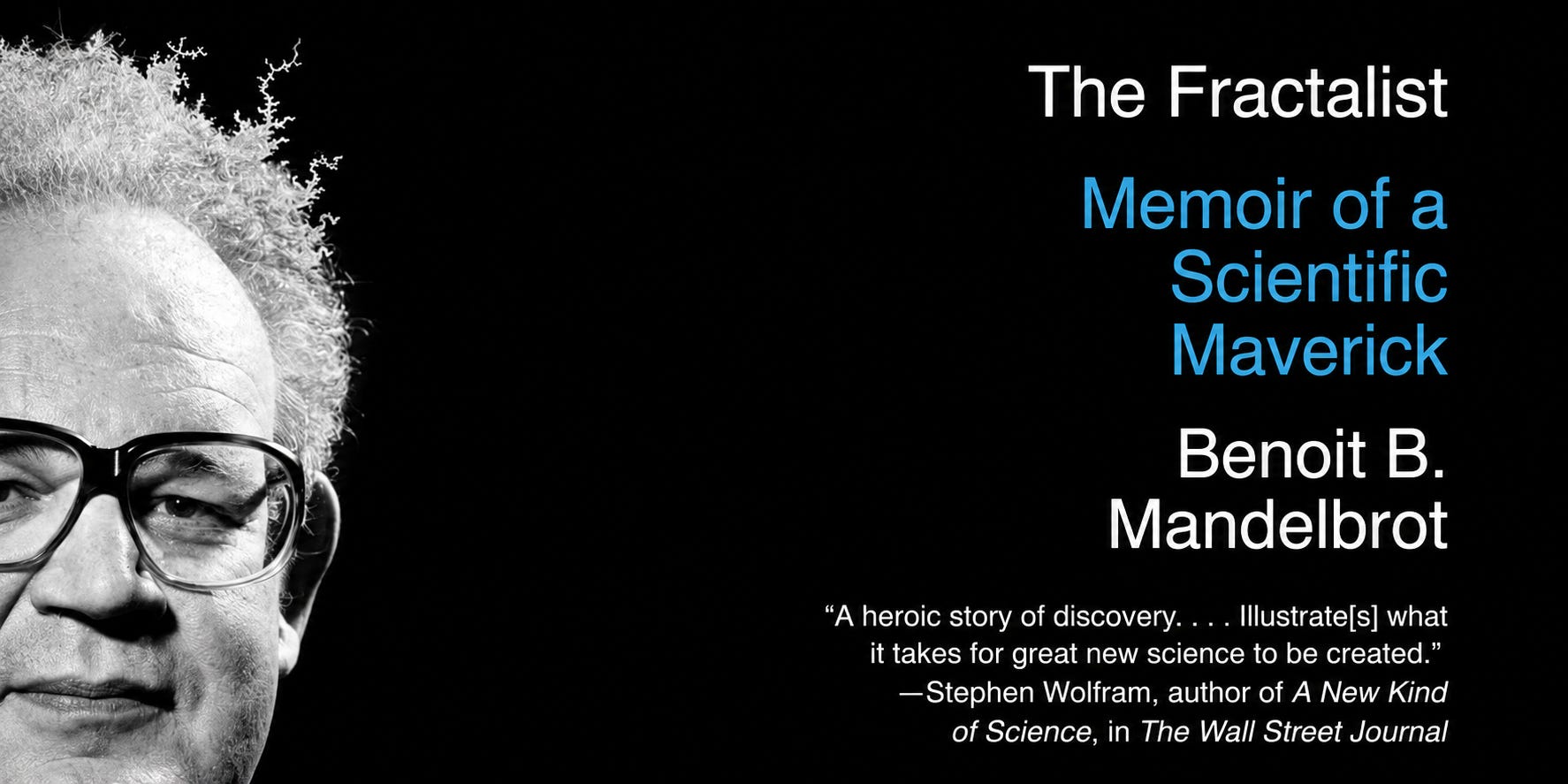
The pioneer was Benoit Mandelbrot, an IBM engineer fascinated by what he called “rough shapes” found all over nature. Think clouds, waves, mountains, a crown of broccoli. These are not triangles, squares, or lines. So, are they messy? Classical mathematicians called them “monsters” because their existence defied Euclidean formulas.
Mandelbrot’s work on fractals showed that rough shapes have order, so precisely that they can be computationally simulated. However, he was recognized only in his old age, setting the record as the oldest tenured professor at Yale! By then, his work was revolutionizing multiple fields, from geometry and physics to medical treatments and graphic design. Why was it wide-reaching? Because fractals was not just a framework or theory; it was a paradigm—a different way of understanding shapes.
What that story tells us is, social science today is reminiscent of classical mathematics yesterday. As modern, urban humans, we are familiar with machines. We like straight lines, squares, boxes, and circles. We reduce complex social phenomenon to a pair of variables (dependent and independent) and linear causality because it gives us a false sense of simplicity and control. Complexity feels instinctively repulsive, like “monsters,” not because they are scary, but because our default mechanical mindset rejects them. And most of the time, we don’t even know that our default setting is mechanical.
World Politics: In your World Politics article, you demonstrated one application of APE—coevolutionary development—by drawing from your book, How China Escaped the Poverty Trap. You argued that “development is best understood as a three-step, coevolutionary process.” Could you walk us through how you arrived at this finding and mapped it out? Also, you mentioned that APE is actually not a new paradigm, but already a decade old. What do you mean?
Ang: APE is “new” in the sense that it challenges the conventional mechanical paradigm. But it was introduced a decade ago in my 2016 book, How China Escaped the Poverty Trap, with China as the primary demonstration case. In the World Politics article, I formally named this paradigm APE, with empirical excerpts from my book. As long as “China” appeared on the cover, the instinctive reading was “sui generis.” So, I had to remove China to reveal the paradigm that had always been there.
In How China Escaped the Poverty Trap, I applied APE to explain China’s great transformation from the 1980s. It’s a classic complex process where everything everywhere is changing all at once. My classical training taught me to pin down a single cause and effect. How was that possible? I took one year reading all the important literature to find the answer to this question. One of them says growth first, good institutions come later. The second one says good institutions first, growth comes later. And the third one by 2024 Nobelists Acemoglu, Johnson, and Robinson says you must be lucky enough to have colonial legacies that endowed good institutions, then growth will come.
All three theories are stuck. They are either endogenous (the cause is also the outcome) or deterministic (the past determines the present). I came to the conclusion that the problem lies not with endogenous development, but with applying the mechanical paradigm to explain it. Linear theories cannot explain nonlinear realities, just as “plumbing” (another Duflo metaphor) cannot nurture gardens.
After collecting hundreds of pages of oral history in different parts of China, I mapped out many zigzag causal chains between the economy and institutions, including property rights, development strategies, and types of corruption. I applied the same method across historical cases: late medieval Europe, 19th-century United States, and post-1990s Nigeria. Then I asked: what is the common order across them?
In its simplest form, development is a sequence of three steps.
Harness normatively weak institutions to build new markets—more simply, “using what you have.”
Emerging markets stimulate and enable strong (modern) institutions.
Strong (modern) institutions preserve markets.
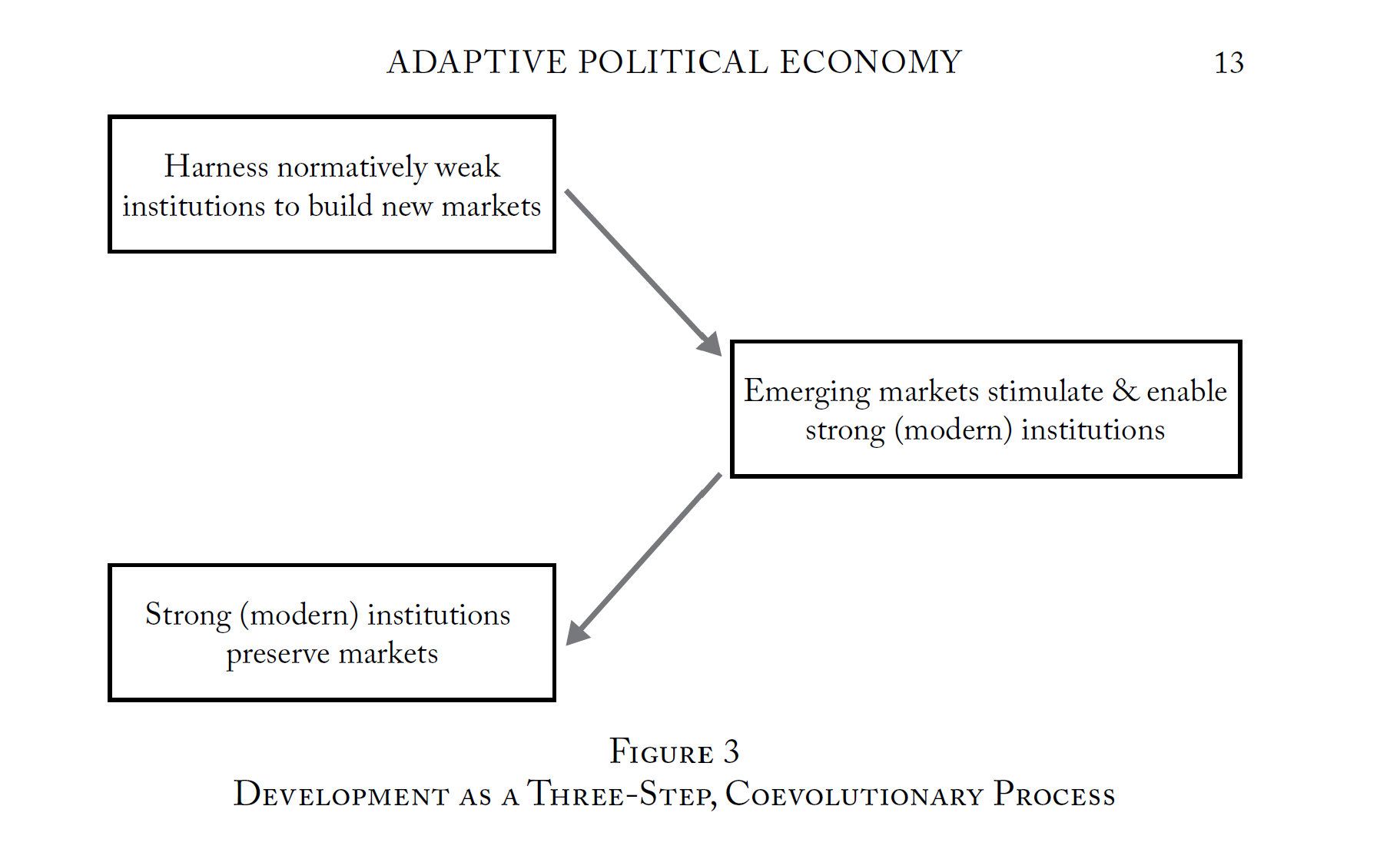
I make a crucial distinction between market-building vs. market-preserving. For any developing country such as China, the first step of development is “using what you have.” What looks weak, wrong, informal, or unorthodox can be turned into solutions. But of course, change doesn’t automatically happen. Indigenous actors must apply their creativity in “using what they have” to solve their problems. For that to happen, they must first overcome a mental block: the belief that they have nothing.
Complexity feels instinctively repulsive, like “monsters,” not because they are scary, but because our default mechanical mindset rejects them. And most of the time, we don’t even know that our default setting is mechanical.
APE highlights one blind-spot: mechanical thinking—trying to stuff dynamic feedback loops between the economy and institutions into static boxes. But there is also a second blind-spot, a normative one: the assumption that market-supporting institutions are necessarily the kind found in an idealized America or Denmark, e.g., Weberian technocracy, rule of law, Western-style democracy.
Frankly, it is questionable if that list still describes America today. It doesn’t describe America when it was an emerging economy, which saw corruption and systemic exclusions. But canonical theories often scrub out this messy history and claim a universal package of “good institutions” that will lead poor countries to the end of history. Given today’s disruptions, it’s hard to continue with that myth.
That is why I emphasized, in the conclusion, that APE is only one pillar of a larger paradigm I propose: AIM—Adaptive, Inclusive & Moral Political Economy. Inclusive means recognizing multiple development pathways, not one Western endpoint. Moral means recognizing the role of power and positionality in shaping canons. They are not neutral. Some factors are elevated while others are muted; Western cases are assumed to be universal, while non-Western cases are ghettoized.
Q: You also pointed to colonialism and its role in how we view the world, writing: “The modern world is not only a product of industrialization but also that of colonialism.” Another line: “Layered on top of an industrial logic is a colonial worldview that assumes that the best, growth-promoting institutions are those found in the West, and backward societies must catch up, converge, and become like Denmark.” You follow this with a quote from Edward Said, specifically from his book, Orientalism. What is the significance of Said’s work in your article?
Ang: My scholarly journey has been about unlearning what I was taught and then relearning. My dissertation was aligned with institutional economics and Chinese exceptionalism. But when I tried to turn it into my first book, I found myself unable to proceed. I knew I was confronting a complex reality, but my default mechanical setting couldn’t handle it. The conventional normative framing was “virtuous governance led to prosperity in the West, but China is an exception,” but I couldn’t agree with that. Instead, I found the two more similarly fraught than most people think. I didn’t see the meaning of publishing something I no longer believed in. So, I abandoned my dissertation and started again. That detour turned into How China Escaped the Poverty Trap in 2016, then China’s Gilded Age in 2020. That decision to redefine assumptions also prompted all the other projects I continue to work on today.
APE is only one pillar of a larger paradigm I propose: AIM—Adaptive, Inclusive & Moral Political Economy. Inclusive means recognizing multiple development pathways, not one Western endpoint. Moral means recognizing the role of power and positionality in shaping canons.
In recent dark times, it has become fashionable to talk about “moral political economy” as being nice and ethical, holding hands and flourishing together. I cited Edward Said as a source of inspiration for thinking about moral political economy from a different angle—grounded in social reality: awareness about the role of power and positionality in knowledge formation. As he reminded us, objectivity is noble, but “no one has ever devised a method for detaching the scholar from … a class, a set of beliefs, a social position.” Revisiting Said’s words may stir discomfort, as it is customary to claim neutrality. That’s how you demonstrate rigor as a social scientist, declare that you are values free. But as political scientists, more so than any other profession, how could we believe that power has no effect on ideas?
The three elements that comprise AIM—adaptive, inclusive, moral—are inseparable, like light, water, and soil. You cannot practice complexity economics without decolonizing. You cannot truly decolonize until you demonstrate a different way of doing social science and not just critiquing it. You cannot be truly objective if you deny the sociological factors that shape how we think as social scientists.
After unlearning my previous settings, AIM is what I’ve relearned and been practicing for years. Now I am naming and sharing it. Thank you very much for this opportunity to share.
To Learn More
Read Yuen Yuen Ang’s full essay, “Adaptive Political Economy: Toward a New Paradigm,” published in World Politics
How does Gen-Z apply concepts from APE and AIM? Read Polytunity: Gen-Z Series, a curation of essays by Ang’s students at Johns Hopkins.
Reprinted with permission from World Politics. Read the original post here.
I think the ontological move (complex, not complicated) matters a lot. What it opens up is a question the industrial paradigm couldn't even ask properly: not "did China have good institutions?" but "what made China's coevolution go in a productive direction when Nigeria's didn't?"
Both countries started from weak formal institutions and informal workarounds. China's township-village enterprises coevolved toward market-building. Nigeria's oil-patronage networks coevolved toward consolidating whoever was already at the top. The industrial paradigm explained this in terms of colonial legacies or institutional quality scores. Essentially, China got lucky; Nigeria didn't. Adaptive Political Economy asks something more interesting: what were the actual feedback mechanisms that sent these systems in different directions from similar starting points?
The resulting question is not whether coevolution happens (it always does), but which way it runs. I can see that the Adaptive, Inclusive and Moral framework gestures toward an answer: some forms of "using what you have" build markets, others entrench extraction.
However, it could be argued that this is somewhat easier to assert than to demonstrate. States are not monolithic, and the same informal arrangement can be market-building in one sector and predatory in another, sometimes simultaneously. The productive next question for the paradigm is how to read those markers at the level where it actually matters: not China versus Nigeria, but which parts of China, and when. Looking forward to seeing where this goes.