

Imagine an expert advising a pauper: either attend college and live in a wealthy neighborhood in order to escape poverty (build good institutions first), or save money before you can earn a steady income (get growth first). The pauper’s dilemma captures the fallacy of common development advice. Both are useless because both expect poor societies to start with capacities and privileges they do not have.
In this review of Yuen Yuen Ang’s How China Escaped the Poverty Trap, Chidinma Linda Obi shares an incisive “Nigerian reading” of the book. What resonates most? Not a new set of prescriptions, but a different way of seeing — one that starts not from what Nigeria lacks, but from what it already has to work with.
How China Escaped the Poverty Trap is now free to download at the book's official webpage.
A Book Review of How China Escaped the Poverty Trap, “The Pauper’s Dilemma: How Development Happens, and what Nigeria might Learn From It,” Nextier, May 2026,
By Chidinma Linda Obi
Introduction
Why do some nations prosper while others languish? Economists have been arguing about it for a long time, and tend to disagree by generation. The 1950s and 1960s favoured state planning, import substitution and the “big push”. The 1970s and 1980s preferred markets, liberalisation and outward orientation. By the late 1980s these convictions hardened into the Washington Consensus, a tidy package of macroeconomic discipline, privatisation and open trade. The 1990s added a postscript: markets alone would not suffice; countries also needed institutions, such as independent courts, professional bureaucracies, secure property rights. Refined many times since, this framework still anchors mainstream development thinking. In short, each era picked its preferred variables and built a doctrine around them.
The verdict is now in, and it is unflattering. Most countries that began the post-war period poor are poor still. The handful that genuinely escaped did so by ignoring what the doctors ordered. China, the largest of these exceptions, entered its reform era in 1980 with GDP per person of $193—poorer than Bangladesh, Chad, Nigeria or Malawi. It went on to become the world’s second-largest economy without first installing the institutional plumbing the textbooks deemed essential. Property rights were shaky, enforcement patchy, and the system ran on relationships, hierarchy and discretion rather than rules. By the standards of orthodox theory, China should not have grown. It grew anyway.
This is the puzzle Yuen Yuen Ang sets out to crack in How China Escaped the Poverty Trap. The orthodox debate, she observes, is really a quarrel about sequence: does growth produce good institutions, or do good institutions produce growth? Each school rearranges the same variables, and each crashes into the same wall. Poor countries cannot wait for wealth to deliver institutions, nor afford the institutions that deliver wealth. Ang opens with a parable. A pauper consults two financial advisers. The first tells him to acquire wealth before bothering with money management; the second tells him to acquire prerequisites before earning. Both pieces of counsel are useless, because each assumes away the very thing the pauper lacks.
Yuen Yuen Ang’s solution is to drop the sequencing question altogether. Development, she argues, is not a linear chain but a process of co-evolution: states and markets shape each other as they go, neither arriving first. They adapt jointly through three mechanisms she traces across the Chinese case:
variation in how local officials interpret directives from the centre;
selection, as approaches that work survive and others are abandoned;
and niche creation, which turns regional differences into productive specialisation rather than chaos.
This essay leans heavily on Yuen Yuen Ang’s book and on discussions at two reading groups in Nigeria—the Nextier Public Policy Book Club and The Long View Book Club—both convened by Patrick O. Okigbo III, founding partner of Nextier. It sets out her central contribution, and asks what it implies for Nigeria.
Ang opens with a parable. A pauper consults two financial advisers. The first tells him to acquire wealth before bothering with money management; the second tells him to acquire prerequisites before earning. Both pieces of counsel are useless, because each assumes away the very thing the pauper lacks.
How Development Actually Happens
If the orthodox prescriptions have failed, what is the alternative? Yuen Yuen Ang’s answer is not another list of ingredients, but a different theory of how the dish gets made. Three ideas do most of the work: that development is a process of co-evolution rather than assembly; that it must begin with the materials at hand rather than those a textbook prefers; and that adaptation, not design, is what carries countries from poor to less so. Each deserves a closer look.
Development is a coevolutionary process
Development is too often treated as a recipe. Install the right institutions, apply the right policies, and growth will duly arrive. Assemble the correct parts and the machine will run. This logic works for some systems. It does not work for this one.
Development, Yuen Yuen Ang argues, is complex, not merely complicated. In a complicated system, for instance, a jet engine, outcomes can be engineered by bolting well-understood parts together. In a complex one, the parts themselves change through interaction. Components do not simply fit; they reshape each other as they go.
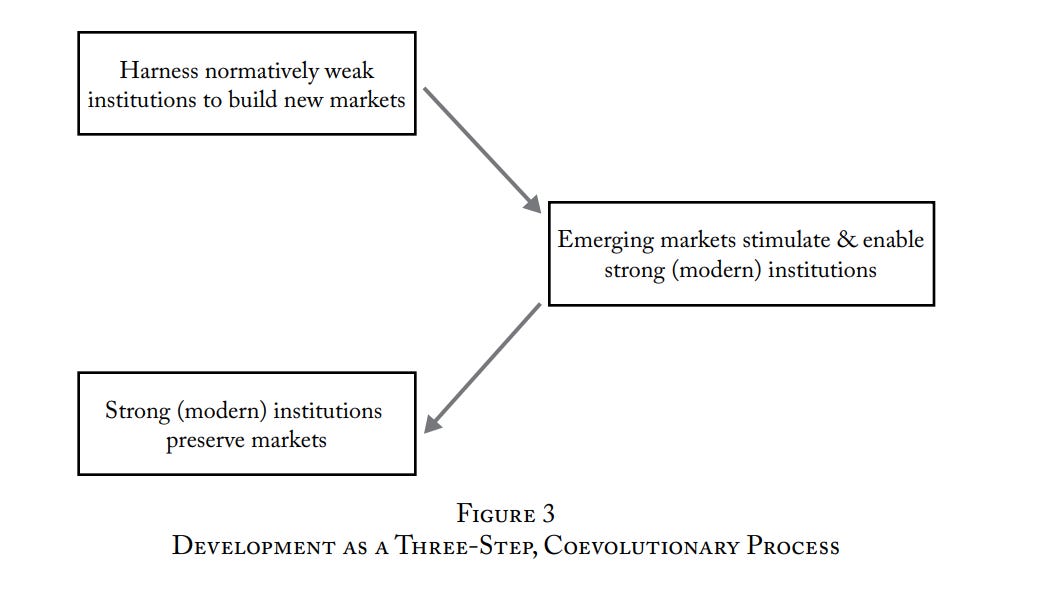
The relationship between markets and institutions is the obvious illustration. Institutions built to support markets are themselves remade by the markets they enable. Markets that emerge within existing institutional constraints, in turn, push back on those institutions and refashion them. Change is iterative, not linear. Policies meet local conditions, throw off unexpected results, and are tweaked accordingly. Some adaptations work and spread; others fail and are quietly abandoned.
Change is iterative, not linear….Some adaptations work and spread; others fail and are quietly abandoned.
If markets emerge through co-evolution rather than from a standardised blueprint, the question shifts. It is no longer what poor countries lack, but what they already have to work with. Donald Rumsfeld, for all his other faults, had a point: you go to war with the Army you have, not the one you wish you had.
Conventional development thinking starts from absence. It catalogues the gaps between poor and rich economies and prescribes the institutions needed to close them. This assumes that the institutional forms found in rich countries are the inputs to growth. The evidence points the other way. Such institutions typically arrive after markets have taken hold; they stabilise systems already in motion rather than conjure them into being.
The institutional landscape of an early developer looks rather different. The clearest case is the rise of Township and Village Enterprises in rural China during the early reform years. Collectively owned and run by local governments, these were an awkward hybrid. They were neither private firm nor state-owned enterprise but fitted to the political constraints of a transitional economy. They were what was available, and they worked.
Adaptation through directed improvisation
Starting from what exists raises a second question: how does adaptation actually happen?
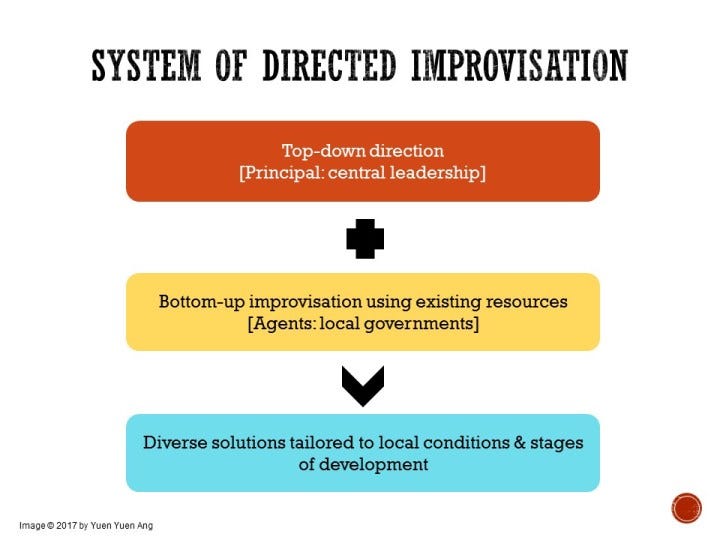
The classic textbook answer is that central authorities design solutions and roll them out. In practice this breaks down quickly. Local conditions vary, information is incomplete, and the centre is rarely as clever as it thinks. Systems that work tend to combine direction from above with problem-solving from below.
Yuen Yuen Ang calls this “directed improvisation.” The centre sets priorities and tilts incentives; local actors experiment within those bounds. The arrangement runs on three mechanisms. Variation lets local officials deviate from central directives and tailor solutions to their own conditions. Selection defines what counts as success, and ties rewards and promotions to it, so that approaches which deliver get reinforced and copied. Niche creation treats regional diversity as a source of useful specialisation rather than messy incoherence, letting different local models emerge and persist side by side.
The Catalyst for Adaptation
China in 1976 was emerging, bruised, from the Cultural Revolution. Within a few years it was running special economic zones and tolerating township enterprises. The interesting question is not what changed, but what made change possible at all.
The answer is leadership; albeit, of an unusual kind. At critical junctures, it acts as the catalyst for adaptation. Deng Xiaoping played that role in China. In his 1978 speech, Emancipate the Mind, Seek Truth From Facts and Unite As One In Looking to the Future, he quietly reset the basis on which policy would be judged. Ideological loyalty would no longer be the test of correctness. Practice would. If something worked, it was permitted.
Two phrases came to define the era that followed: “cross the river by feeling for the stones” and “it does not matter whether the cat is black or white, as long as it catches mice.” Both marked a clean break from the preceding decades, when policy was measured against ideological purity and deviation could be career-ending, and often, worse.
What tends to get missed is the nature of Deng’s intervention. Development, Ang argues, is too often cast as a problem of control: leaders are meant to know the right answers and impose them. The Chinese experience suggests something else.
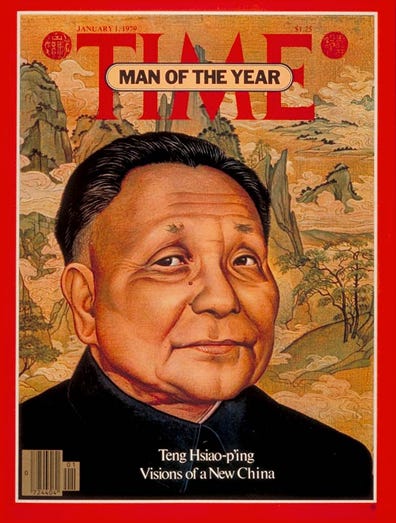
Deng’s leadership did not prescribe particular solutions, nor lay out a detailed blueprint for reform. It set the direction and changed the rules by which success would be measured. The centre established priorities; it did not dictate how those priorities were to be met. That, in turn, created room for local variation within a common framework.
In complex systems, the full range of problems and solutions cannot be foreseen. Attempts to control outcomes from above tend to smother the very experimentation that progress requires. What leadership can do instead is operate by influence: defining goals, setting bounds, and shaping how success is judged. It alters the behaviour of the system without dictating its results.
Development, Ang argues, is too often cast as a problem of control: leaders are meant to know the right answers and impose them. The Chinese experience suggests something else.
Lessons For Nigeria
What does any of this mean for Nigeria? Reading the country through Ang’s framework is not an exercise in importing Chinese lessons. Nigeria is not China, and pretending otherwise has produced more bad policy than good. Rather, it is an exercise in seeing Nigeria’s own situation more clearly. Two questions require attention. First, what preconditions for adaptation has Nigeria assembled, and which has it failed to? Second, how do the three mechanisms of directed improvisation (variation, selection and niche creation) actually map onto Nigerian realities?

The Preconditions: Agency, the Mind, Culture and Confidence
History sets the stage; it does not write the play
Some accounts of Nigeria’s underdevelopment begin with history, and rightly so. Colonial extraction, the politicisation of regional and ethnic identities, and the patronage politics that followed independence all left their marks. No serious account of Nigeria’s predicament can wave these away. But history is not destiny. It shapes the ground on which societies act; it does not abolish the act itself. The danger of purely exogenous explanations is that they quietly evict agency from the story. Development becomes something that happens to a country, rather than something a country does.
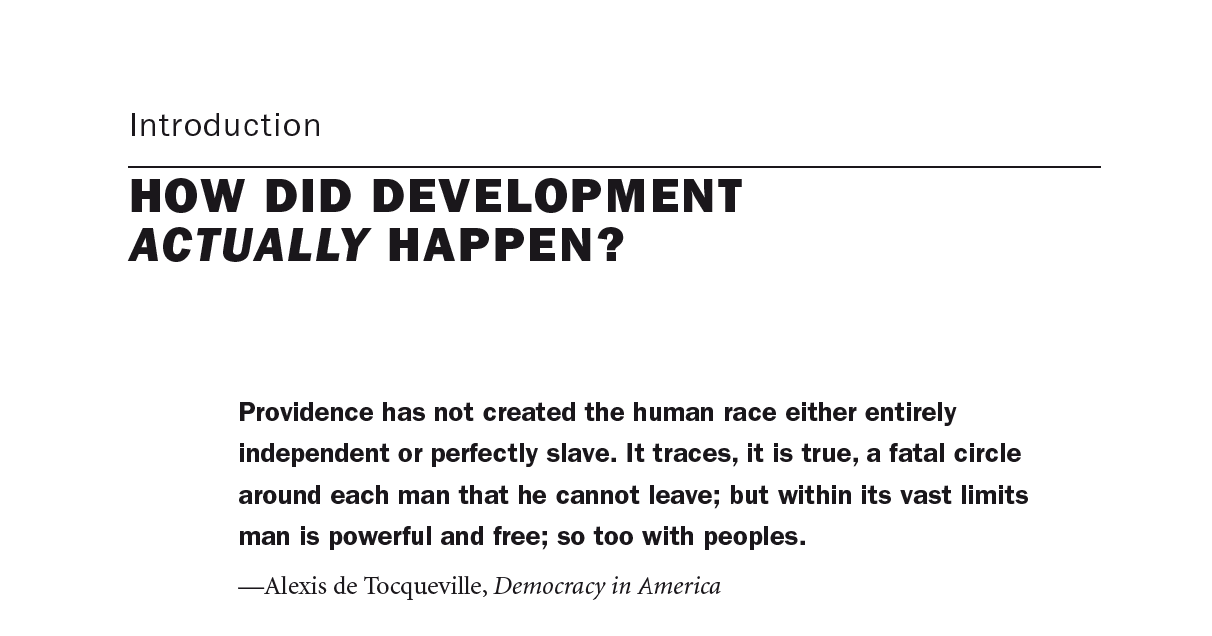
Tocqueville put it well in Democracy in America: “Providence has not created the human race either entirely independent or perfectly slave. It traces, it is true, a fatal circle around each man that he cannot leave; but within its vast limits man is powerful and free; so too with peoples.” The past sets the starting conditions. It does not determine the end.
Confidence is agency in working clothes
Recovering agency in the Nigerian context begins, awkwardly, in the mind. Patrick O. Okigbo III argues in What it Means to Be Human that colonial inheritance reshaped not only institutions but the confidence to question received wisdom. The result is a habit of deference to external prescriptions, imported frameworks and externally validated answers.
Nigeria’s adoption of the Structural Adjustment Programme is the canonical illustration. The point is not that all foreign ideas are wrong, nor that domestic opinion is always right; that would simply swap one dogma for another. It is that prescriptions become dangerous when they are adopted by deference rather than analysis. When domestic economists warned that the programme would carry severe social and economic costs, the deeper question was not only whether they were correct. It was whether the Nigerian state had the confidence and institutional discipline to interrogate the prescription on its own terms, adapt it to local conditions, and accept the consequences. It did not.
The point is not that all foreign ideas are wrong, nor that domestic opinion is always right…It is that prescriptions become dangerous when they are adopted by deference rather than analysis.
Despair has a development cost
The third precondition is engagement. In Against Despair, Okigbo warns against the temptation to withdraw from public life on the grounds that the system is too broken to repair. This matters because adaptation requires reform actors; entrepreneurs willing to build in difficult markets, civil servants willing to mend broken processes, teachers willing to push past the syllabus, researchers willing to ask sharper questions, citizens willing to remain invested in the possibility of change. When too many capable people exit, the country loses more than talent. It loses adaptive capacity.
Despair, in other words, has a measurable price. It thins the pool of people willing to experiment, repair and build. Fewer experiments mean less learning. Less learning entrenches institutional failure. Over time, the loop closes on itself.
Culture determines whether learning can scale
The fourth precondition is culture. Adaptation cannot scale unless society rewards the behaviours that make learning possible: questioning authority, testing claims, applying useful knowledge, tolerating failure, and judging ideas by evidence rather than status.
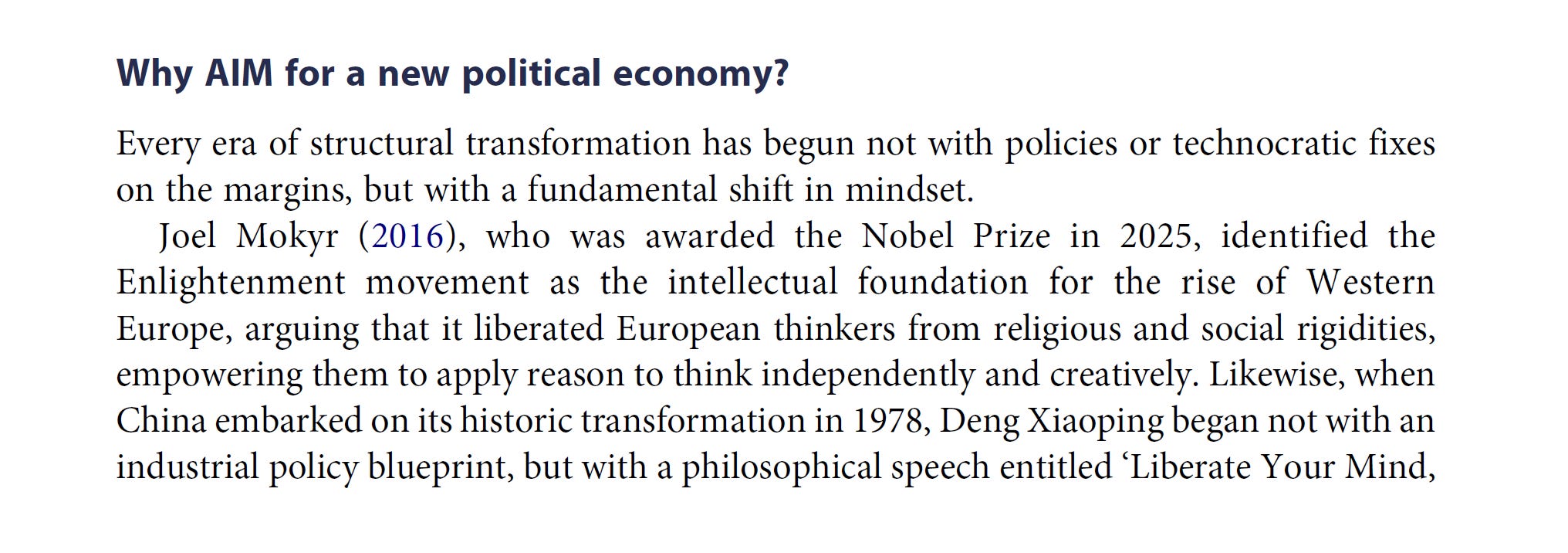
Joel Mokyr’s A Culture of Growth makes the historical case. The Industrial Revolution was not only a story of inventions, capital and markets; it rested on a cultural shift that preceded it. In early modern Europe, the status of useful knowledge rose. Practical inquiry gained prestige. Claims became contestable. The “Republic of Letters” created a transnational community in which ideas could circulate, be challenged and be refined. Modern growth, on Mokyr’s argument, required not only invention but a culture that believed knowledge could accumulate and be put to work on the material world.
Nigeria has cultural assets to build on—resilience, entrepreneurial energy, a young population. These explain why Nigerians continue to build, trade, organise and improvise in conditions that would defeat many others. But raw energy is not the same as cumulative learning. A culture of growth requires something more disciplined: inquiry rather than deference, experimentation rather than conformity, useful knowledge rather than status credentials, evidence rather than assertion. Three habits stand in the way.

The first is epistemic deference. Nigerian society places considerable weight on age, religious authority, traditional title, professional rank and credentials. These hierarchies sustain order and continuity, but when they shield claims from challenge, they slow learning. In adaptive societies, the question is not only “who said it?” but “is it true, how do we know, and what evidence would change our mind?”
The second is causal substitution. This is not a critique of religion. The issue is whether empirical problems get diagnosed empirically. When business failure, public-health failure or institutional failure is explained chiefly through spiritual, personal or moral categories, the habit of causal analysis atrophies.
The third is credentialism. Nigeria values education highly, but too often treats credentials as status markers rather than entry points to inquiry. The degree becomes the destination, not the start of disciplined learning. This helps explain why formal education does not consistently translate into applied research, technical capability or institutional problem-solving. A society can produce many graduates and still struggle to generate useful knowledge if education rewards certification more than curiosity.
Yet Nigeria also has indigenous systems with the seeds of a culture of growth. The Igbo apprenticeship system, Igba Boi, transmits practical commercial knowledge, embeds learning inside enterprise, builds trust through social networks and creates pathways for capital accumulation. Yoruba commercial traditions and Hausa long-distance trading networks operate on similar logics of practical learning, trust, risk-sharing and intergenerational capability transfer. These systems should not be romanticised; they have limits. But they show that Nigeria is not starting from nothing. The country already has cultural infrastructure for learning by doing. The opportunity is to connect it to modern education, finance, technology and enterprise.
Education is the lever
The lever for shifting culture is education, but not as currently practised in Nigeria. The system, particularly at primary and secondary levels, still rewards memorisation over inquiry, deference over critique, conformity over experimentation. Many students are trained to treat knowledge as a stock of authorised answers rather than a method of investigation.
A culture of growth would require a different posture. Assessment would reward evidence-based reasoning, not only recall. Classrooms would permit questioning, not only repetition. Teacher training would model inquiry, not merely transmission. Technical education would be linked to production. Apprenticeship pathways would be connected to formal skills systems. Failure would be treated as information, not disgrace.
This is a long horizon, and an urgent one. Nigeria’s demographic structure means its future cultural habits are being formed now. The next generation is learning, explicitly or implicitly, how to think about authority, evidence, work, failure and knowledge. That formation will decide whether Nigeria’s dynamism becomes cumulative capability—or remains, as it too often does, motion without progress.
Variation, Selection, Niche Creation: Which Parts Work?
The preconditions describe the soil. The three mechanisms of directed improvisation describe the machinery that runs in it. Which parts of that machinery already exist in Nigeria, and which are broken?
Variation: present in abundance
Variation is the room local actors have to deviate from central directives and adapt solutions to their conditions. In Nigeria it abounds. The federal structure gives states constitutionally protected revenues, elected leaders and considerable formal autonomy. Abia, Bayelsa, Benue, Bornu, Ekiti, Sokoto are free to pursue different economic strategies, and they do. Nor is there any shortage of underlying difference: states vary in political history, economic structure, administrative capacity, commercial culture and sectoral strength. The problem is not that Nigeria lacks variation. The problem is that variation does not consistently translate into learning, experimentation or feedback.
Niche creation: visible, but unmoored
Niche creation is the process by which regional diversity becomes a source of useful specialisation. Nigeria has the raw material. Lagos has built its economy around finance, services, logistics, technology and trade. Anambra has deep commercial and entrepreneurial traditions. Kano historically anchored northern manufacturing and trans-Sahelian commerce. Ogun benefits from proximity to Lagos and an expanding industrial base. The Niger Delta states sit on hydrocarbons that could yet be parlayed into a broader energy and petrochemical capability.
The problem is not that Nigeria lacks variation. The problem is that variation does not consistently translate into learning, experimentation or feedback.
The weakness is that these niches are not embedded in any coherent national development strategy. Lagos grows largely on its own internal momentum. Anambra’s commercial energy remains under-institutionalised. Kano’s manufacturing base has weakened. Oil-producing states have not turned resource wealth into broad-based productive capacity. Nigeria has niches; it has not yet stitched them into an architecture for structural transformation.

Selection: the broken link
Selection is where Nigeria’s adaptive machinery fails most clearly. Selection defines what success means, measures performance against it, and rewards the actors who deliver. China’s Communist Party answered the question of national success narrowly and unambiguously: success meant material prosperity, measurable in growth, employment and infrastructure. That answer became the spine that organised every subsequent reform.
Nigeria has made no equivalent decision. As the 2025 Nextier Development Festival report argues, the country has many aspirations but no sufficiently disciplined definition of the economy it is trying to build. In the absence of a clear hierarchy, sectoral policies do not align and public investments do not reinforce one another. Each agency optimises for its own brief, and the whole adds up to less than the sum of its parts.
Even if Nigeria defined success more clearly, the incentives facing subnational officials would still blunt selection. Governors and local-government chairmen are not principally rewarded for raising productivity, expanding production or building competitive firms. They are rewarded for political survival, control of patronage, access to federal allocation, and the management of ethnic and electoral coalitions. Their behaviour is rational within the system, because the system rewards distribution rather than creation.
Yuen Yuen Ang’s contribution is to show that development is not a fixed sequence of reforms to be copied from rich countries to poor ones. It is an adaptive process. Countries move by starting with what they have, testing what works, rewarding what succeeds and building institutions through use rather than declaration.
Osita Chidoka, Nigeria’s former minister of Aviation, makes this point in his session on Nextier Development Discourse titled, The Trouble with Nigeria and How to Fix It. Nigeria’s pattern of state formation, he argues, actively limits the competition and innovation that drive development. The federal allocation system distributes resources to states regardless of their economic performance, so subnational political machines can be sustained on patronage flows that do not depend on productivity, enterprise or internally generated growth.
Jude Uzonwanne, in another Nextier Development Discourse session titled, Building Africa’s First Trillion Dollar Economy, makes a complementary point. Nigeria’s fiscal and political architecture, organised around federal allocation and rent distribution, rewards consumption rather than adaptation or production. Whatever success means at the national level, its translation into subnational behaviour is short-circuited by a fiscal structure that pays officials regardless of what they produce. Selection breaks down because the rewards are detached from productive performance.
Changing this means changing the rewards. It means tying subnational advancement to measurable economic performance. It means restructuring fiscal flows so that locally generated revenue matters more to a state’s prospects than its slice of federal allocation. It means engineering horizontal competition between states, so that each jurisdiction has reason to outperform the next. None of this is technically difficult. All of it is politically hard, because it requires the people who benefit from the current structure to dismantle it. Until that happens, policy design will keep producing behaviour that disappoints its designers, not because the policies are wrong, but because the rewards are.
From Constraint to Adaptation
Nigeria’s history matters. Colonial rule, extractive institutions, oil dependence, federal allocation and patronage politics have all shaped the country’s path. They explain many of the constraints within which Nigeria operates. But constraints are not verdicts. The dangerous conclusion is not that history matters; it is that history decides.
Yuen Yuen Ang’s contribution is to show that development is not a fixed sequence of reforms to be copied from rich countries to poor ones. It is an adaptive process. Countries move by starting with what they have, testing what works, rewarding what succeeds and building institutions through use rather than declaration. The lesson from China is not that Nigeria should imitate China. It is that transformation begins when a society recovers the confidence to act within its own realities.
For Nigeria, the question is therefore no longer what the country lacks. It has variation. It has entrepreneurial energy. It has commercial traditions, cultural resilience and emerging regional niches. What it lacks most is a disciplined system of selection. This system entails a clear definition of national success, incentives that reward production over distribution, and institutions that allow learning to accumulate rather than evaporate with each political cycle.
This is where leadership earns its keep. Not leadership as command and control, nor leadership as the next grand plan, but leadership as the catalyst that changes what the system rewards. Nigeria does not need a perfect blueprint before it begins. It needs a credible direction, a culture that prizes evidence and useful knowledge, and a political economy that rewards states, firms, schools and public institutions for solving real problems rather than for outlasting them.
The past has drawn a circle around Nigeria. It has not closed the future. Within that circle there is still room for agency—room to free the mind from deference, despair and imported certainty; room to turn variation into experimentation, niches into productive specialisation, and ambition into measurable progress. The pauper in Ang’s parable is paralysed because both his advisers tell him to start with what he does not have. The trick, it turns out, is to start with what he does. Nigeria has more to work with than it gives itself credit for. The work of building the machinery that turns it into something belongs to Nigerians.
Reprinted with permission by Nextier. Original post here.
Learn More
For Ang's broader paradigm, read her essay on AIM — Adaptive, Inclusive, Moral Political Economy at Oxford Development Studies
Big‑picture: Read Ang’s essay on why breakdown of the old order can be a moment of polytunity rather than paralysis