

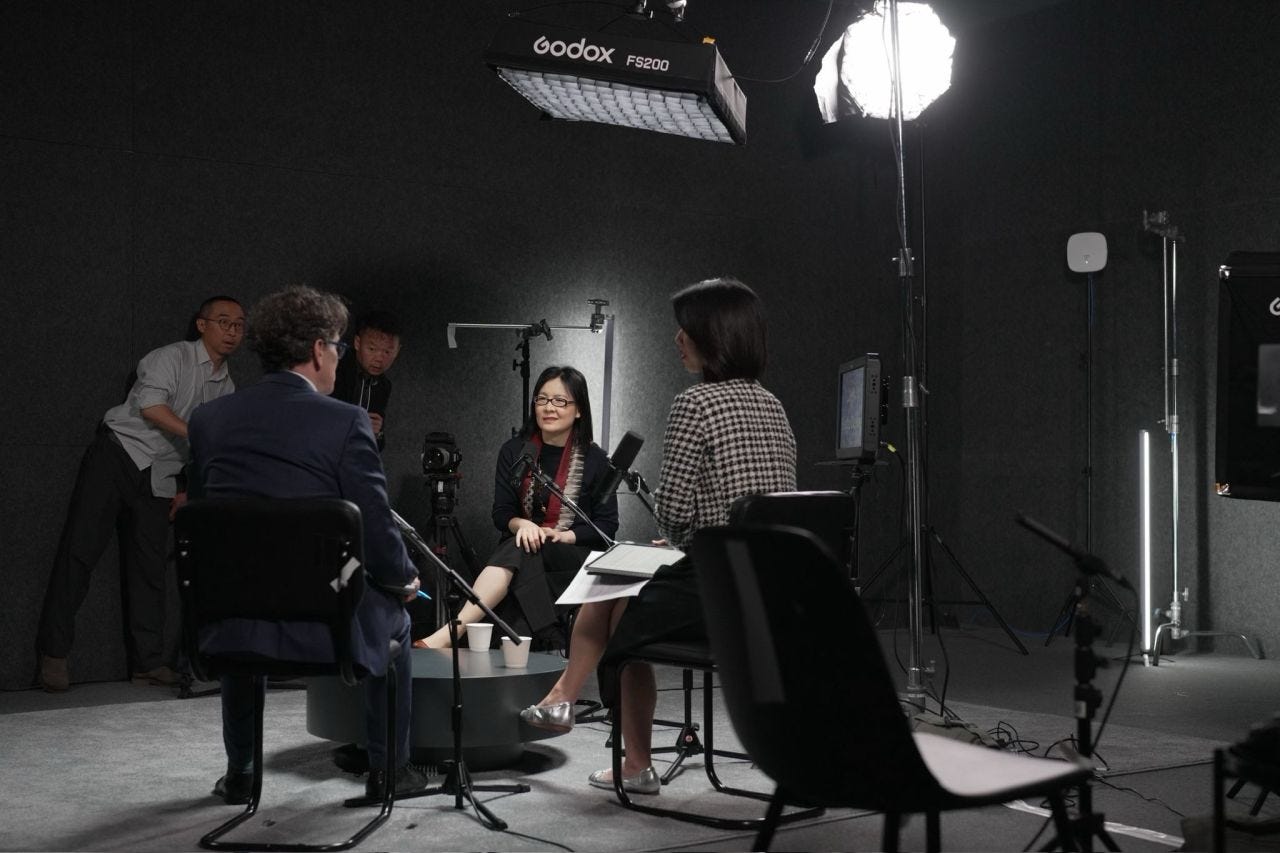
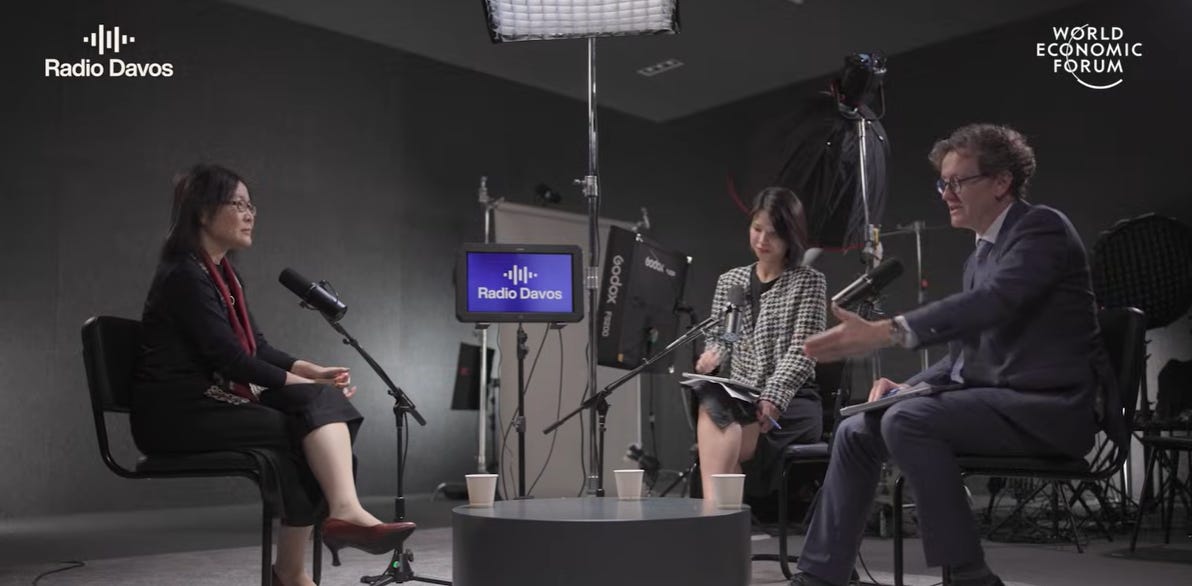
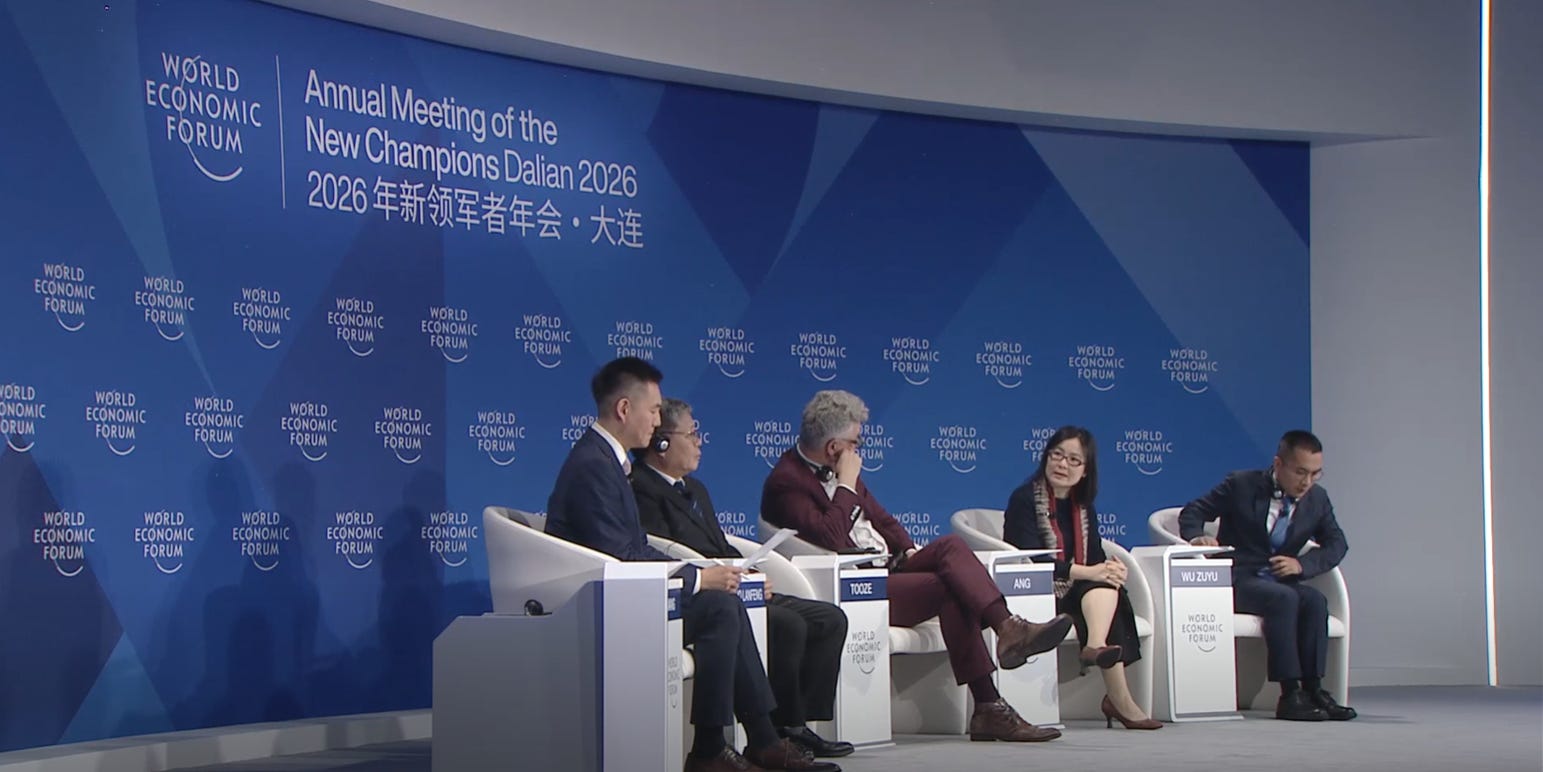
This is a lightly edited transcript of a conversation between Yuen Yuen Ang, Alfred Chandler Chair Professor of Political Economy at Johns Hopkins University, Robin Pomeroy (World Economic Forum), and Olivia Siong (Channel News Asia), recorded at the World Economic Forum’s Summer Davos in Dalian, China, June 2026.
A recording is available at Radio Davos and on YouTube.
From Polycrisis to Polytunity
Robin Pomeroy: We’re recording this at the World Economic Forum’s Annual Meeting of the New Champions, sometimes called Summer Davos, in Dalian, China. You just came straight from a session where you were speaking, and we’d like to cover some of the issues you were talking about there. I was researching some of the things you’ve said in the past, and you’ve adopted this word. We used to talk about the polycrisis, and you’ve evolved that into the polytunity. Tell us what those two words mean.
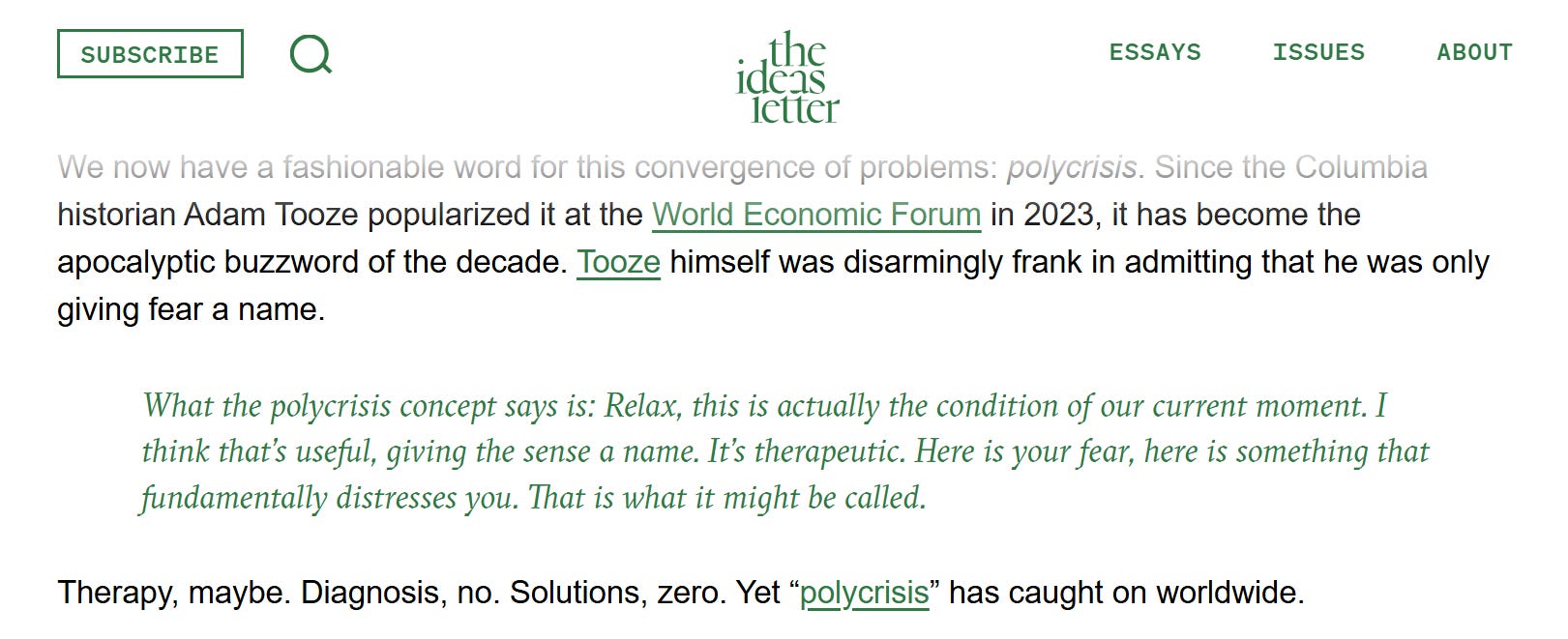
YYA: The term polycrisis was popularized at this very forum, by Adam Tooze at the World Economic Forum in 2023. That was a time when world leaders felt a great deal of anxiety about world affairs. The term — which means the entanglement of global threats around us — resonated with world leaders. It took off and stuck.
I am proposing that we should flip that term, because the idea of a polycrisis is, frankly, fear-driven and paralyzing. You have a name for fear — that’s a good start — but you need to go beyond that.

More importantly, the idea of polytunity comes from a certain realism. Maybe because I’m Singaporean — Singaporeans are proud to be realist and practical. The realist in me tells me that a time of global breakdown can be scary for some, but it is also a rare opportunity for deep reflection and transformation.
If you think about it, in normal times we don’t like to make big changes. It’s hard, it’s risky, so we continue with business as usual no matter how broken things are. Sometimes we actually need to be forced to change.
So this moment — where multiple things seem to be breaking down at once, from the Western-led global order to globalization to climate change — gives us an opportunity to carry out deep transformation. And that transformation, in particular, is going to come from the global majority, the rest of the world.
In the past, solutions, memes, and agendas were set by a small number of countries who ruled in the last two centuries. One of the realities of our times is that this has drastically changed. Power has shifted — not only to China, but to Africa, Asia, Latin America. We have more voices, which is a good thing.
In many ways, I think the term polycrisis is more of a polycrisis of Western decline. Not a critique of the West — just a statement of observation.
For the rest of the world, yes, there’s a great deal of uncertainty about where we’re going. But the time of global breakdown is also a time for radical shifts.
“The time of global breakdown is also a time for radical shifts.”
We can see that in the context of China itself. For China, globalization allowed it to do export-led manufacturing and prosper. That was good — but in a sense, it also trapped China because it became so good at making consumer goods — shoes, toys, toasters — that it got stuck playing that role. Despite state efforts to compel Chinese companies to climb the value-added chain, to do joint ventures, to do fundamental R&D, those efforts never really worked. Why would you do the hard thing when you can make profit from consumer manufacturing?
So when the U.S.-China competition intensified starting around 2016, from China’s perspective, it must have felt quite dangerous and threatening. But it was also a polytunity for China — a moment to say, maybe it’s time to fundamentally rethink China’s role in the global economy.
That’s where you began to see the changes I discussed at the panel [The 15th Five-Year Plan, Unpacked]: the 14th and 15th Five-Year Plans, where China says, we are good at making shoes, toys, and toasters, but we would also like to make advanced materials, airplanes, and quantum computers. Given that the world is in disorder anyway, let’s take advantage of that and do the hard thing.
China’s Economic Paradox: Production and Consumption
Olivia Siong: You’re speaking of this change we’re seeing from China, its approach. We heard from the Chinese Premier in his opening plenary speech, in which he pushed against the Western characterization — specifically the narrative of “China Shock 2.0” — recasting it instead as “China Opportunity 2.0.” What do you make of that reframing from the country’s second-highest-ranking official? (Also, see Kaiser Kuo’s coverage of Ang’s remarks on “China opportunity vs shock”).
YYA: We tend to see production and consumption as two separate buckets. The point I was trying to make at the panel is that they are completely intertwined.
The real challenge for China today is not just a growth slowdown or geopolitical tensions. It’s what I call China’s economic paradox: the high-tech advances are real and impressive, but they coexist with a broad economic slowdown.
China is making EVs, advanced materials — but if it lacks domestic consumption power, then those products have to go out. They go to Southeast Asia, to South Africa. As one audience member noted: high-quality, cheap Chinese EVs are appearing in South Africa.
For other countries, it’s legitimate to ask: if your products are so good, good for you — but what are we going to make? Other countries also want to manufacture. They want some measure of self-sufficiency. They want to climb the value-added chain. But China is just so good at manufacturing — it used to be just consumer manufacturing, and now it’s across all parts of the supply chain. The shock is real. It has to be acknowledged.
So how do you turn the “China Shock” into a “China Opportunity”? The key is consumption. Boosting Chinese domestic consumption is no longer a domestic issue — it’s an international issue. Without it, everything made in China has to go out to the rest of the world.
On the one hand, I love to buy high-quality, affordable Chinese products. But on the other hand, from the perspective of each nation’s interest: what are we going to make?
Olivia Siong: Could I pick up on that? You mentioned the real need to boost domestic consumption, but the statistic from last month showed retail sales fell by 0.6% — the first time in more than three years. At the same time, we saw a CCTV report saying that eight central government departments are talking about accelerating the development of “AI plus consumption.” Is that going to work? The numbers don’t seem to paint a picture of current measures actually working.
YYA: One of the panelists, Minister Guo, made a point about why it’s so difficult for the Chinese central government to boost consumption: the effects are slow. It’s not something where you press a button, introduce a new policy, and see results three months later. With investment, the government can pump billions and see an effect on GDP. With consumption, it’s hard to control. You put in the right inputs, and wonder: why am I not getting the right outputs?
“Boosting Chinese domestic consumption is no longer a domestic issue — it’s an international issue.”
So why has consumption been persistently weak in China? Because of the fundamentals. China is rapidly trying to pull off a structural transformation from the old growth model to the new one. The new growth model’s advances — AI, quantum, EVs, aeronautics — are impressive, but these are not mass employment-producing industries. In the short term, they might even cut employment. When I visited one automated factory in China, I think: wow, this is so sleek. There’s nobody in this factory. They’re all robots. So where are the jobs for humans?
China has hundreds of millions of people who need jobs — not to mention more college graduates every year who need good jobs.
The fundamental issue with consumption is that the weak old growth model is no longer producing jobs for a large number of people, while the new growth model is impressive but not mass-employment-producing.
Robin Pomeroy: Is there any solution?
YYA: The solution will not be a quick fix. The Chinese government has tried quick fixes, periodically offering grants if you switch to an EV, for instance. That’s a temporary boost, but it doesn’t fundamentally fix the consumption problem. The fundamental fix is employment. I have a good job, I feel safe in my job, I feel confident — thus, I spend.
One key solution: too much emphasis is being placed on cutting-edge technologies right now. They are impressive, marketable. But too little emphasis is placed on everything else. The traditional industries, even sectors like e-commerce, which are applicational innovation but not cutting-edge, are the sectors that ultimately produce mass employment and allow people from all walks of life to participate.
Think about quantum computing. How many people can participate in that industry? Not even most PhDs. It’s geopolitically important, dazzling, glamorous. But the real solution to boosting consumption in China has to be in the non-glamorous parts of the economy. Things like modular manufacturing. Nobody talks about that. Most people react with: what is that?
Robin Pomeroy: What is it?
YYA: Exactly. China is very good at modular manufacturing. In the past, manufacturing had to be done on a gigantic scale — MNCs building gigantic factories, producing one thing at scale. Now, because China has such a comprehensive and nimble supply chain, an entrepreneur from any part of the world can go to Shenzhen and say: I want to prototype a new product. Can I make a small batch? In China, you can do that. It’s relatively fast, cheap, and it allows many people to participate in manufacturing.
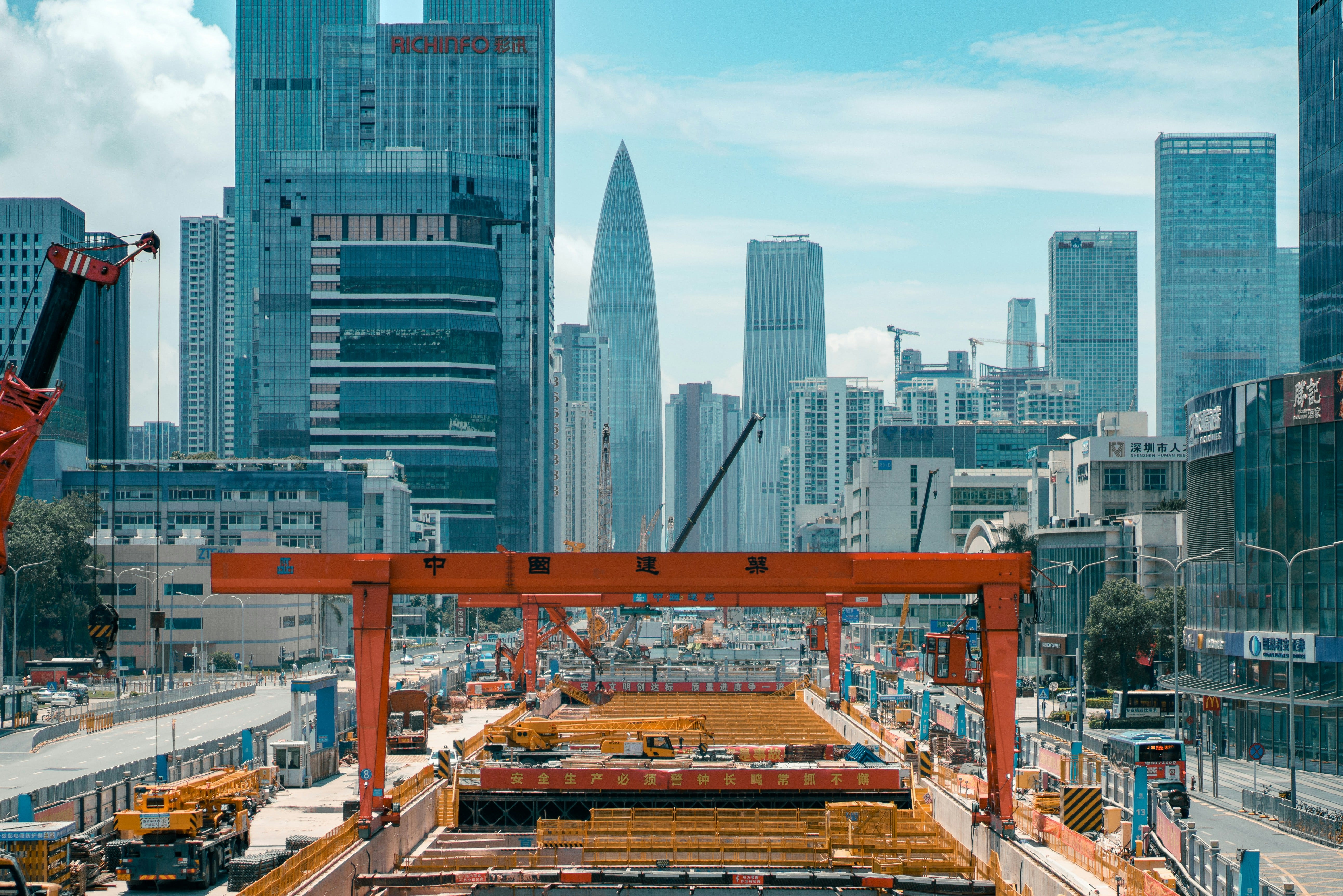
But we don’t talk about it, because it’s not fancy, not glamorous, doesn’t win China geopolitical chips. We much prefer headlines about AI, quantum, dancing robots.
“The real solution to consumption in China has to come from humble innovation — humble in the sense that everyone can participate.”
In the end, the real solution to consumption in China has to come from humble innovation. Humble in the sense that everyone can participate, the barriers to entry are low, and we can integrate it easily into our lives. Glamorous innovation is also important, but only for a very particular context.
Robin Pomeroy: I wonder if that’s the case in the West as well. Everyone’s very excited. So much money is being poured into AI without potentially knowing exactly what the applications are. Maybe governments and companies are neglecting some of the more humble innovations.
YYA: I couldn’t agree more. Coming from Washington, D.C., a lot of people talk about the K-shaped economy in the U.S. “K” meaning it’s increasingly divided. The rich are getting richer and the poor are feeling more desperate with inflation and employment pressures.
In the U.S., tech companies are becoming ever more powerful, while ordinary Americans are fed up with data centers being built around them and using up their water.
Coming here to Summer Davos, I was surprised that the Chinese are also using the language of the K-shaped economy. Despite seeming to be rivals, this is one of the themes I’ve always stressed: China and America have a lot more in common than most people realize.
The 14th and 15th Five-Year Plan’s Structural Turn
Olivia Siong: What I’m hearing is that this consumption drive is going to take time. So I want to ask about China’s new 15th Five-Year Plan that begins this year. Are you seeing signals that it is preparing for this long-term transformation compared to previous Five-Year Plans?
YYA: Yes. If you look at the 14th Five-Year Plan, the focus was singular: cutting-edge technology, called “new quality productive forces” at the time.
In the 15th Five-Year Plan, consumption has been added. As I tried to explain, it’s not a trivial add-on — it’s a necessary one.
If you look at the central government’s economic work conference, these two themes are brought together again. At the highest level, I believe there is recognition that production and consumption are not separate. If China continues to dominate in manufacturing, other countries will feel the shock. When they feel the shock, Chinese production cannot be sustained. So the consumption part becomes necessary for production to continue.
Olivia Siong: You had an interesting analogy about the biggest shift this represents for China.
YYA: Five-Year Plans have always been a key policy-guiding document in China. But in the past — the 13th Five-Year Plan and before — it was as if you were driving straight ahead on autopilot, with adjustments every five years. Those plans operated under the old growth model where the paradigms were already defined: global integration, FDI, exports, real estate, construction. Within those parameters you’d tweak, but you knew the destination.
Why are the 14th and 15th Five-Year Plans getting so much more attention? The central party leadership is now personally supervising the drafting. It has been elevated as a signaling tool.
To use the driving analogy: from the 14th Five-Year Plan onward, China put its hand firmly on the steering wheel. And it’s a very heavy steering wheel — we’re not talking about a sedan or an SUV. It’s a gigantic tanker, and China is trying to make a right turn. A structural transformation of the growth drivers. Not just GDP in quantity, but GDP coming from the highest value-added innovation sectors — something China had put off for years because it benefited from the old game of globalization.
That’s why all of a sudden the Five-Year Plan is cool again. Everyone’s talking about it, because it captures this right turn China has been trying to make.
Robin Pomeroy: What does that right turn involve? Is it the super-high-tech focus and domestic consumption? Both?
YYA: There are two levels.
The first transformation is from quantity of GDP to quality of GDP — hence the term “new quality productive forces.” In the past, China had 7%, even 12% GDP growth, but much of it came from low-hanging fruits: low-end manufacturing, overcapacity in real estate, environmental pollution. Little regard for the quality of growth. From the 14th Five-Year Plan onward, there was a clear signal: we don’t want that kind of growth anymore. We want high-quality growth. That’s level one.
Level two: in addition, China wants a structural transformation in the kinds of innovation it’s good at. China used to excel at two types. “One to ten” — application of innovation: somebody invents AI, China applies it. And “ten to one hundred” — massive scaling, which China is singularly good at because of its massive market. Green energy, for instance: China can scale it massively and make it cheap.
From the 14th Five-Year Plan onward, China had a new ambition: in addition to one-to-ten and ten-to-one-hundred, it wants to do zero to one. On Chinese social media and WeChat, “zero to one” has become the popular term. Starting from when trade tensions with the U.S. intensified, China realized it was good at manufacturing everything except items upstream. When the U.S. cut off chips supply, China was helpless. So it realized it had to move upstream. Zero to one is that upstream innovation. That’s where the new ambitions lie.
Olivia Siong: A bit of crystal ball gazing — sharp right turn for the 14th and 15th Five-Year Plans. What about the 16th?
YYA: My point is that you can only solve the consumption problem by making sure you’re doing all kinds of innovation, not just pouring every cent into zero-to-one innovation, because that doesn’t produce enough jobs.
That also means altering bureaucratic incentives in China. Right now, imagine being a Chinese official. You read the Five-Year Plan, and it’s pretty clear what’s important. Why would you try to revive real estate or some traditional economy? That’s not going to make you look marketable. You want to stand out by saying: I have a flying taxi, or I have dancing robots.
So there has to be incentives for local officials to balance the economy across all types of innovation — and in particular, to focus on employment-boosting innovation.
Development and the Global South
Robin Pomeroy: Coming to the end of our time. There’s so much I wanted to ask. Let me ask about development. It might be hoped that lower-quality, mass-produced manufacturing might migrate from China to less developed countries. There’s not much indication that will happen, particularly as it’s automated and there’s still unemployment in China. How do you see China’s role — either good or bad — in developing countries that need manufacturing, need jobs, need new technologies?
YYA: In fact, that migration is happening. Many Chinese companies are moving overseas. I just spoke to an entrepreneur who specializes in connecting Chinese companies that want to move to Southeast Asia. So it is happening, and it’s an essential part of diversification and risk management for Chinese companies.
But for countries in Southeast Asia, some might be content taking over low-end consumer manufacturing. Others have higher aspirations: Malaysia wants semiconductor manufacturing, other economies want to make their own cars, even Vietnam wants to make its own EVs.
The question — as asked by the audience member from South Africa — is: with all of these high-quality, affordable Chinese cars, why and how can our country make our own cars or other high-value desirable products?
Robin Pomeroy: Is there an answer? Maybe joint ventures or Chinese investment in those places?
YYA: I think the ideal answer would be that Chinese consumers also buy from them.
U.S.-China Relations in a Multipolar World
Olivia Siong: I can’t let Professor Ang go, given her unique position in researching China but being based in the U.S. China-U.S. relations always come up — the two superpowers, that rivalry. But the relationship has stabilized following President Trump’s visit to Beijing, and we’re expecting more meetings in the year ahead. How do you expect that to play out in relation to China’s trajectory and its 15th Five-Year Plan? How much of that relationship is weighing on how China navigates its next chapter?
YYA: It’s a very encouraging sign. The last visit — at least the relationship feels much more amiable. But the competition will go on.
The trap that often happens, particularly in Washington, D.C., is the Cold War mindset. My American colleagues often remind me that the people making decisions in America today lived through the Cold War. That’s the mindset they’re familiar with. They think in terms of zero-sum competition, with the expectation that, like in the Cold War, one side will fall, there will be complete victory, a big party.
But that’s not the reality anymore. The two big powers are in a competition where I think it’s possible there will be no end game, no clear victor, for a long time to come.
“The trap that often happens, particularly in Washington, D.C., is the Cold War mindset… thinking in terms of zero-sum competition, with the expectation that, like in the Cold War, one side will fall, there will be complete victory, a big party.”
It’s also a new world where the rest of the world is no longer just passive and weak and pressured into picking sides. Singapore in particular, but everyone else too, is saying: we’re not going to pick sides. We’re going to do business with both great powers, however it fits our interests. For the U.S., that’s also a new reality to adapt to.
This is a very different international context in which U.S.-China competition is playing out.
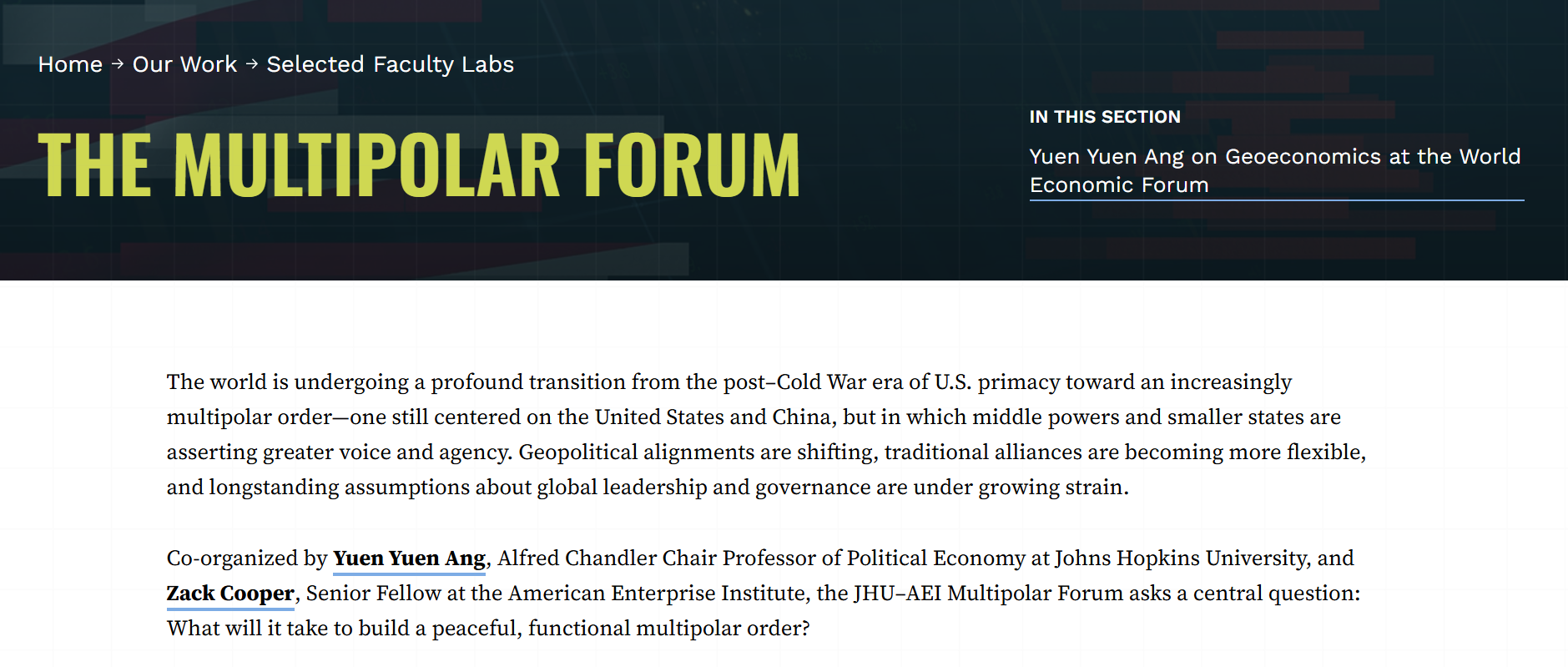
At Johns Hopkins, I run a forum called the Multipolar World and U.S.-China Forum, where we invite experts from across sectors to discuss U.S.-China relations. I deliberately put “Multipolar World” in front, because too often discussions about U.S.-China are so centered on Washington and Beijing. We need to step back and realize we’re in a different world where everyone else matters as well. Everyone wants a voice, and they have more agency today than they ever did in the twentieth century.
That’s the new world we’re living in. If you sit here and mourn about the polycrisis, it doesn’t resonate with the rest of the world. For the rest of the world, the reality is mixed — risks and dangers, but also tremendous opportunity that they never had in the last century.
Robin Pomeroy: Professor Yuen Yuen Ang, thank you very much for joining us.
YYA: Thank you very much.
Robin Pomeroy: Radio Davos is available wherever you get podcasts or at wef.ch/podcasts. On the World Economic Forum’s website, you can see all the sessions from AMNC 2026, including the one with Professor Ang. I’ll put a link in the show notes.
Olivia Siong: And this has also been a special episode of the CNA Correspondent Podcast. This was fun!
Robin Pomeroy: Thanks from Olivia and from me. Thank you, Professor Ang.
YYA: Thank you very much.
If you sit here and mourn about the polycrisis, it doesn’t resonate with the rest of the world. For the rest of the world, the reality is mixed — risks and dangers, but also tremendous opportunity that they never had in the last century.
Coverage & Media
“Polycrisis? Think again.” - World Economic Forum
Share a short clip of the WEF-CNA interview with Ang, available on Youtube.
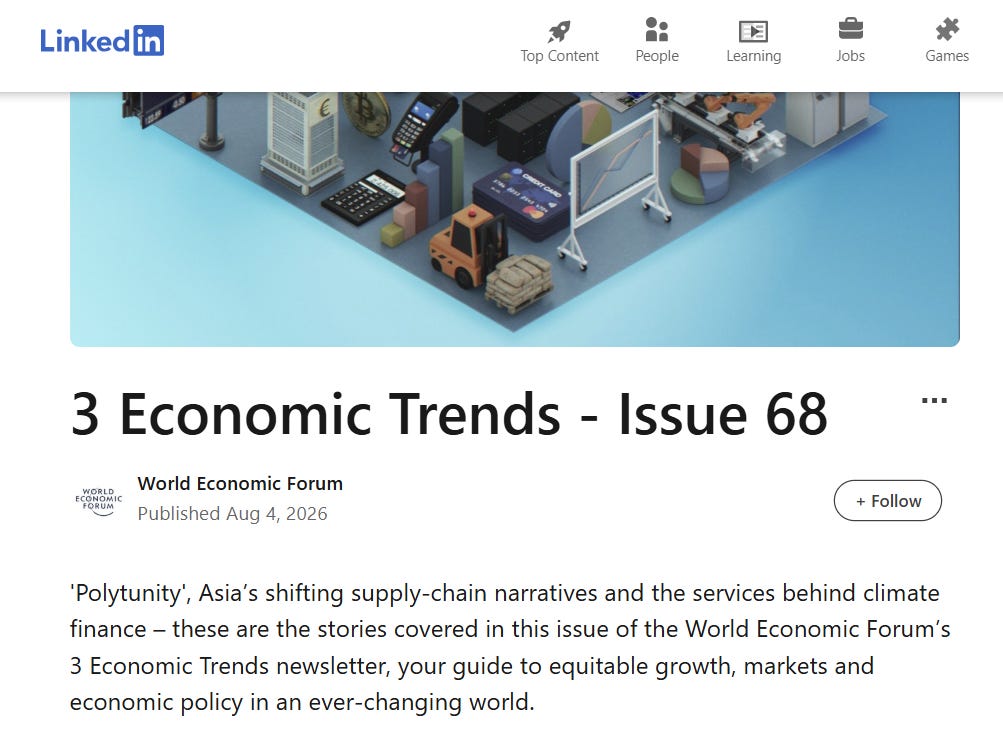
WEF also featured polytunity as a lead story in its “3 Economic Trends” newsletter (Issue 68, August 4, 2026), sent to over one million subscribers.
1. From #polycrisis to #polytunity
For years, “polycrisis” has helped describe a world where shocks collide: geopolitical tension, climate disruption, trade fragmentation and the breakdown of old assumptions.
But in a new episode of Radio Davos, Professor Yuen Yuen Ang of The Johns Hopkins University argues it is time to flip the term. The world is not only facing polycrisis, she says. It is also facing “polytunity” - a moment where breakdown creates space for deeper transformation.
China is one example. The breakdown of the old globalization order has pushed the country to rethink its role in the global economy, from low-cost manufacturing towards advanced materials, electric vehicles, quantum computing and other higher-value sectors.
But Ang also warns that high-tech growth alone will not solve China’s biggest challenge: weak domestic consumption. The real answer, she argues, lies in jobs, confidence and “humble innovation” - the less glamorous parts of the economy that allow more people to participate.
Learn More
“Polytunity & Agency in the Age of Disruption.” Ang’s interview at the World Peace Foundation.
Polytunity defines the moment. AIM (Adaptive, Inclusive & Moral Political Economy) is the response.